Reviewed by the MerrisBags production team. Figures are planning guidelines; your final MOQ is confirmed after specification review.
If you are launching a bag collection, one of your first supplier questions will be: “What is your MOQ?” A useful answer must go beyond a single quantity. You need to know whether the minimum applies per design, per size, per color, or per material—and which parts of your specification create that minimum.
At MerrisBags, the standard custom production MOQ is generally 500 pieces per design and colorway. Some projects using stocked materials and simple branding may support a smaller trial, while custom-dyed textiles, molded hardware, technical construction, or special compliance testing can require more. This guide explains how to evaluate the number behind the quote.
In this guide
What Does MOQ Mean in Bag Manufacturing?
MOQ means minimum order quantity: the smallest production quantity a supplier will accept under a defined specification and price. For custom bags, that specification normally includes the bag shape, dimensions, fabric, color, lining, hardware, logo, label, and packaging.
The words after the number matter. “500 pieces” might mean 500 total, 500 per style, or 500 per color. For example, an order for one tote bag in black and beige could require 1,000 pieces if each custom-dyed color carries a 500-piece minimum. Ask the factory to state the MOQ basis in writing.
Why Do Custom Bag Factories Set an MOQ?
A production line has fixed setup costs whether it makes 100 bags or 10,000. MOQ spreads those costs across enough units to keep the project commercially workable and quality stable.
- Material purchasing: textile mills and component suppliers sell fabric, webbing, zipper tape, lining, and packaging in rolls, lots, or cartons.
- Development: pattern engineering, artwork setup, color matching, molds, cutting dies, and samples require skilled labor before bulk assembly begins.
- Line changeover: machines, folders, gauges, thread, and workstations must be configured for your construction.
- Color consistency: one controlled dye lot is safer than combining small lots that may show visible shade variation.
- Quality control: incoming inspection, in-line checks, final inspection, and reporting carry a base cost for every order.
A very low advertised MOQ is not automatically a better offer. It may rely on stock products, leftover fabric, limited customization, a high unit price, or an unverified workshop. Confirm exactly what is—and is not—custom.
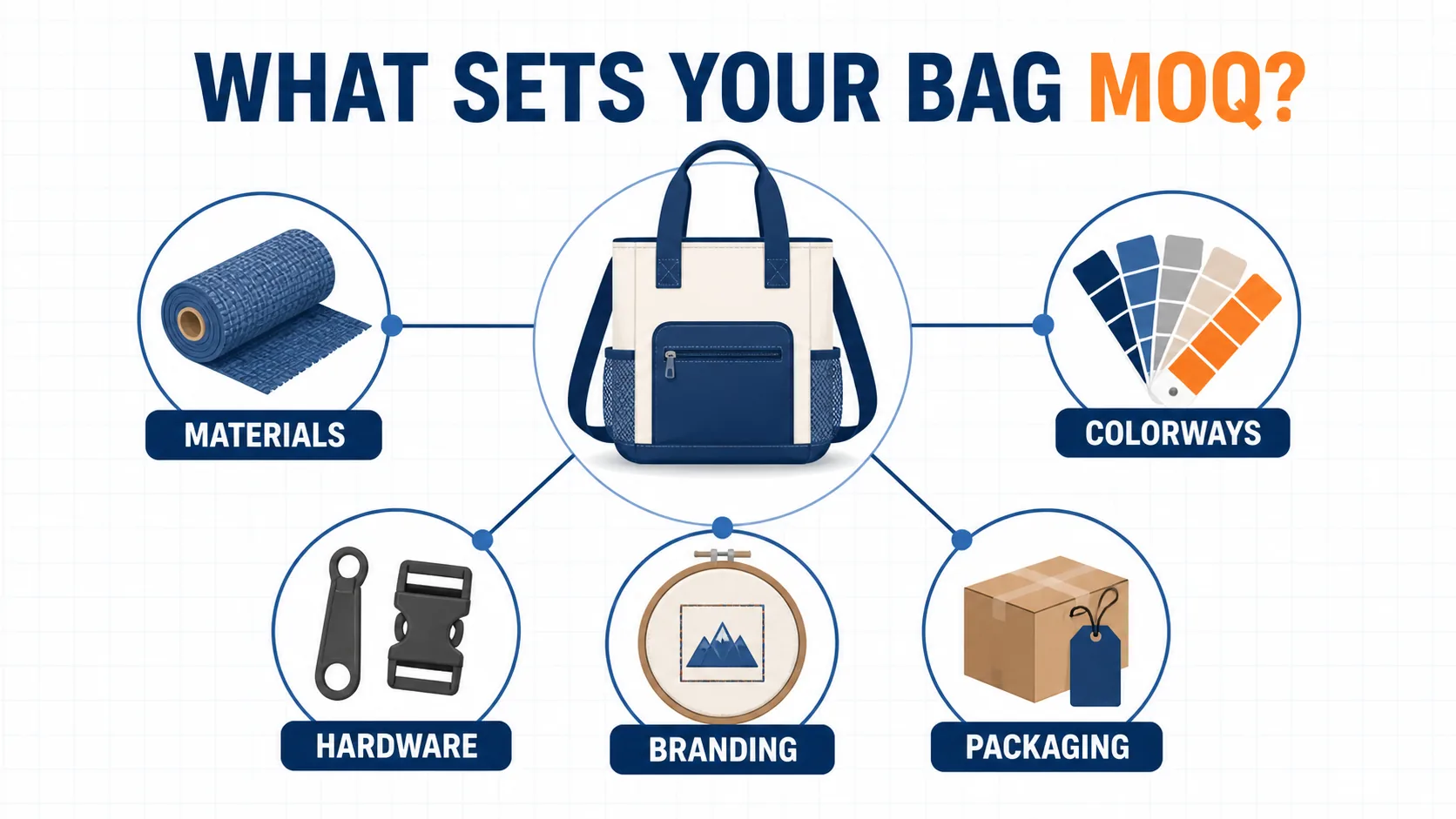
Seven Factors That Change Your Bag MOQ
1. Stock fabric versus custom-dyed fabric
Stock polyester, nylon, canvas, and PU in common colors usually provide the most flexibility. A custom Pantone shade requires a dyeing run, and the textile mill's minimum may become the controlling MOQ.
2. Number of colorways
Splitting 500 pieces across five colors creates five small material and production lots. That increases shade control, cutting, sorting, and line-change work. One or two launch colors are usually more economical.
3. Custom hardware and molds
Standard zipper pulls, buckles, hooks, and D-rings can be sourced in smaller lots. A branded metal puller, unique buckle, or injection-molded component carries mold charges and its own supplier minimum.
4. Logo method
Screen printing, heat transfer, a woven label, or straightforward embroidery typically works well for test runs. Custom metal badges, rubber patches, all-over prints, and high-stitch-count embroidery add setup and component constraints. See our logo craft guide for a detailed comparison.
5. Construction complexity
A simple drawstring pouch has fewer operations than a structured backpack with foam panels, binding, several compartments, and reinforced load points. Complex products need a stable line balance, making extremely small runs inefficient.
6. Packaging
A standard recycled polybag and master carton are flexible. Printed gift boxes, custom inserts, hang tags, barcodes, and retail display packaging may each be made by a different vendor with separate minimums.
7. Testing and compliance
REACH, California Proposition 65, CPSIA, colorfastness, load, or other project-specific tests add fixed laboratory costs. For small quantities, those costs raise the landed cost per bag sharply.
MOQ, Price, and Total Investment
Lower quantity normally means higher unit price because fixed development and setup costs are divided among fewer units. However, the cheapest unit price can still create the most expensive launch if it forces you to hold excess stock.
Total project cost = unit cost × quantity + development + testing + packaging + freight + import charges
Compare total cash exposure and expected sell-through—not just FOB unit price. A slightly higher unit cost on a focused first run can protect working capital, generate customer feedback, and reduce markdown risk.
How to Lower MOQ Without Sacrificing Quality
- Start with one hero design. Keep the same size and construction instead of dividing volume across several SKUs.
- Choose stocked materials. Ask for the factory's current fabric, lining, webbing, zipper, and hardware options.
- Limit colorways. Launch with one or two proven colors, then add seasonal colors on repeat orders.
- Use standard components. Put brand character into color and logo treatment before investing in custom molds.
- Simplify packaging. Begin with a standard bag plus a sticker or shared-size hang tag.
- Keep specifications common across variants. If colors share the same construction and components, the factory may be able to combine part of the production setup.
- Discuss a growth plan. A credible forecast and repeat-order schedule can help a factory plan materials, but do not promise volume you cannot support.
Can You Split an MOQ Across Colors or Designs?
Sometimes, but a split MOQ is a production decision rather than a universal rule. It is most feasible when all variants use the same pattern, fabric quality, lining, hardware, logo method, and packaging. Stock colors also help.
It becomes difficult when each variant needs custom dyeing, a different print, separate embroidery files, distinct hardware plating, or different cutting patterns. Ask for a written matrix showing the minimum per style, size, color, and logo.
Samples Are Not the Same as a Low-MOQ Production Run
A sample is a development tool, usually made by a sample technician using a small amount of material. Bulk production uses cutting, sewing, finishing, and inspection processes designed for repeatability. Sample fees therefore do not imply that a factory can economically mass-produce 20 or 50 units.
Before approving bulk production, confirm dimensions and tolerances, material codes, Pantone references, logo position and size, hardware finish, seam construction, packaging, and the signed reference sample. Our custom bag process explains the workflow from brief to shipment.
How to Compare MOQ Quotes From Different Suppliers
| Check | What to request | Why it matters |
|---|---|---|
| MOQ basis | Per design, size, color, and logo | Prevents unexpected multiplication of quantity |
| Specification | Fabric weight, lining, hardware, construction | Ensures quotes describe the same product |
| Included costs | Sample, mold, setup, packaging, testing | Reveals one-time and hidden charges |
| Price breaks | Prices at 500, 1,000, 3,000+ | Shows where scale creates real savings |
| Quality terms | Inspection standard and defect remedy | Defines acceptable bulk performance |
| Lead time | Sample, material, production, and shipping | Protects the launch schedule |
| Trade term | EXW, FOB, CIF, or DDP | Makes price comparisons meaningful |
Send every shortlisted factory the same tech pack and quotation sheet. If one quote is dramatically lower, check fabric weight, coating, foam density, stitch count, hardware grade, packaging, inspection, and freight assumptions before treating it as a saving.
What to Send for an Accurate MOQ and Quote
- Bag type, dimensions, and intended use
- Reference photos, sketch, or tech pack
- Target fabric, lining, padding, and color
- Logo artwork and preferred application
- Hardware and closure requirements
- Packaging and labeling needs
- Target quantity by style and color
- Destination country, target price, and required delivery date
The more complete the brief, the faster a supplier can identify which input controls the MOQ and offer sensible alternatives.
Frequently Asked Questions
What is the MOQ for custom bags?
MerrisBags' standard MOQ is generally 500 pieces per design and colorway. Exact requirements depend on materials, colors, construction, branding, hardware, packaging, and testing.
Why do bag manufacturers require an MOQ?
MOQ covers material purchasing lots and the fixed work needed for pattern making, cutting preparation, color matching, machine setup, production changeover, and quality control.
Can I order several colors within one MOQ?
It may be possible when colors use the same construction and stocked materials. Custom-dyed fabric, webbing, zipper tape, or hardware can create a separate minimum for every color.
Does a sample count toward the MOQ?
No. Sampling is a separate development stage used to approve specifications before the bulk order begins.
Can I mix different bag styles to reach 500 pieces?
Usually not, because different styles need separate patterns, cutting plans, materials, and line setups. Similar variants may share some components, so submit the full range for a factory review.
Is the lowest MOQ always the best choice?
No. Compare customization scope, total landed cost, quality controls, lead time, and supplier reliability. A low number with weak specifications can create expensive rework or unsellable inventory.
Get a Project-Specific MOQ
Send MerrisBags your design, target quantity, colors, materials, logo, destination, and launch date. Our team will identify the true MOQ driver and suggest practical ways to reduce first-order risk.
Request a Custom Bag Quote