Paying a Chinese bag factory is the moment where most first-time importers lose money. Not because the factory is inherently dishonest — most aren't — but because the buyer doesn't understand how payment terms work, what risks each payment method carries, or which red flags signal that a "factory" is actually a scammer working from a coffee shop.
After handling payment for 500+ bag orders ranging from $300 sample runs to $200,000+ production shipments, we've seen every payment scenario: the factory that disappeared after a $12,000 deposit, the buyer who saved $800 by negotiating 20% deposit instead of 50%, the Trade Assurance claim that took 4 months to resolve, and the L/C that cost $1,200 in bank fees on a $15,000 order.
This guide distills all of that into actionable advice: which payment method to use for every order size, how to negotiate deposit ratios, the 12 red flags that mean "walk away," how to verify a supplier before paying, and exactly what to do if something goes wrong.
Why Payment Terms Are the Biggest Risk in Bag Sourcing
Most buyers focus on unit price, MOQ, and sample quality — and ignore payment terms until it's time to send money. That's a mistake. Payment terms determine your financial exposure at every stage of the order, and a bad payment arrangement can turn a profitable order into a total loss.
Here's the reality of bag manufacturing payments:
- Factories need deposits to buy materials. A 30% deposit isn't a scam — it's how factories pay for fabric, hardware, and lining before production starts. Without it, they can't start your order.
- The balance is due before shipment. Standard terms are 70% balance against copy of bill of lading (B/L). This means you pay when the goods are on the ship but before the original documents are released to you.
- Once money leaves your account, it's very hard to get back. Chinese banks don't reverse transfers, and international fraud claims take months (if they succeed at all).
- Scammers target bag buyers specifically. Bags are a high-demand, low-barrier product — perfect for scammers who create fake Alibaba listings, steal factory photos, and disappear after collecting deposits.
6 Payment Methods: Deep Comparison
There are six common ways to pay a Chinese bag factory, each with different costs, speed, and risk profiles. The right choice depends on your order size, your relationship with the supplier, and how much risk you're willing to accept.
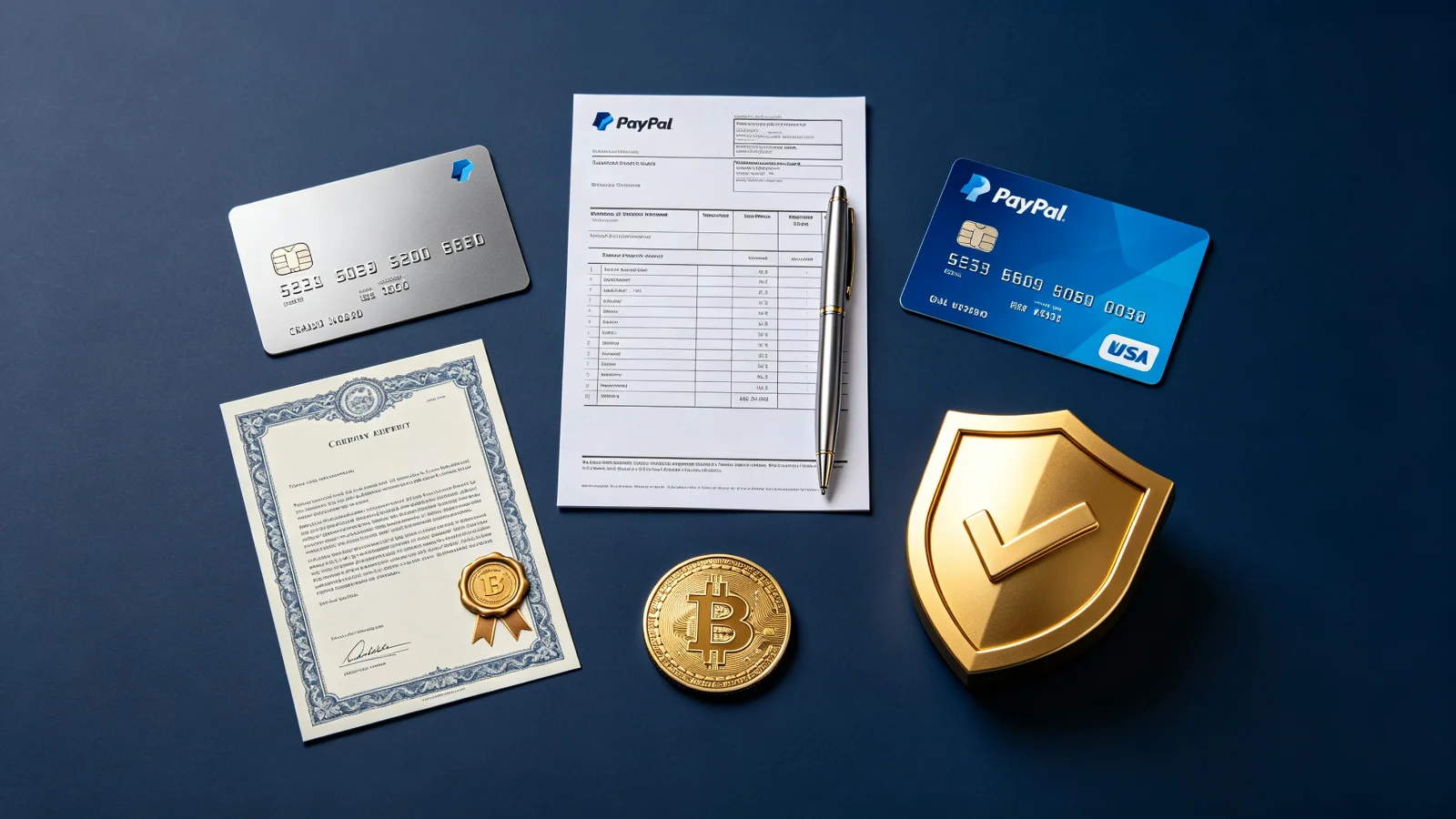
| Method | Typical Cost | Speed | Buyer Risk | Seller Acceptance | Best For |
|---|---|---|---|---|---|
| T/T Telegraphic Transfer | $20-$50 sender + $10-$30 receiver | 1-3 business days | Medium (deposit at risk) | High (universally accepted) | Orders $5,000+ with verified suppliers |
| Alibaba Trade Assurance | 2.95% (paid by supplier usually) | Instant (platform) | Low (platform holds payment) | Medium (only Alibaba suppliers) | Orders $500-$5,000 with new suppliers |
| PayPal | 4.4% + fixed fee (buyer or seller) | Instant | Low (buyer protection 180 days) | Low (factories avoid due to chargebacks) | Sample orders under $500 |
| L/C Letter of Credit | $500-$1,500 total bank fees | 5-10 days setup | Very Low (bank guarantees) | Medium (requires factory with bank relationship) | Orders $50,000+ with new suppliers |
| Western Union / MoneyGram | $15-$100+ | Minutes | Very High (no protection) | Low (scammers love this) | Never for factory payments |
| Cryptocurrency (USDT/BTC) | $1-$10 network fee | Minutes | Very High (irreversible, unregulated) | Low (some factories accept) | Only if both parties are crypto-native |
T/T Telegraphic Transfer: The Industry Standard
T/T (telegraphic transfer, also called wire transfer or SWIFT) is the most common payment method for bag manufacturing. It's how 90% of factory payments are made, and for good reason: it's fast, relatively cheap, and universally accepted.
How it works: You go to your bank (or use online banking), provide the factory's bank details (beneficiary name, account number, SWIFT code, bank address), and send the money. The funds arrive in the factory's account in 1-3 business days.
Alibaba Trade Assurance: The Safest Platform Option
Trade Assurance is Alibaba's escrow-like protection program. When you pay through Trade Assurance, Alibaba holds the payment and only releases it to the supplier after you confirm the goods meet the agreed specifications (or after a set number of days if you don't raise a dispute).
How it works: You find a supplier on Alibaba, place a Trade Assurance order, pay through Alibaba's platform (credit card, T/T, or PayPal), and the supplier ships. You have a set number of days after delivery to inspect and confirm. If there's a problem, you open a dispute and Alibaba mediates.
PayPal: Good for Samples, Bad for Production
PayPal offers the strongest buyer protection of any payment method — 180 days to file a dispute, and PayPal often sides with the buyer in "item not received" or "significantly not as described" cases. This is exactly why most bag factories refuse PayPal for production orders: a buyer can receive the goods, file a dispute claiming "not as described," and potentially get a full refund while keeping the bags.
For sample orders under $500, PayPal is ideal. The fee (4.4% + $0.30) is acceptable for small amounts, and the buyer protection gives you peace of mind when testing a new supplier. For production orders, expect factories to either refuse PayPal or add a 5-10% surcharge to cover the chargeback risk.
L/C Letter of Credit: Maximum Protection for Large Orders
A letter of credit (L/C) is a bank guarantee that payment will be made to the supplier, provided they present the correct shipping documents (bill of lading, commercial invoice, packing list, certificate of origin, inspection certificate). If the documents are correct, the bank pays — regardless of whether the buyer is satisfied with the goods. If the documents are incorrect, the bank doesn't pay.
L/Cs are the safest payment method for large orders ($50,000+) because: (1) the bank verifies the supplier's documents before payment, (2) payment is only released when goods are shipped, (3) both parties are protected by banking rules (UCP 600). The downside is cost: L/C setup fees, advising fees, negotiation fees, and amendment fees can total $500-$1,500, and the process takes 5-10 days to set up.
Western Union / MoneyGram: The Scammer's Favorite
If a "factory" asks you to pay via Western Union or MoneyGram, stop. Walk away. These services are designed for person-to-person transfers to friends and family — not for business payments. They offer zero buyer protection, are irreversible, and are the payment method of choice for scammers because the money can be picked up in cash anywhere in China with just an ID and the MTCN number.
Cryptocurrency: Niche but Growing
A small but growing number of Chinese bag factories accept cryptocurrency payments (primarily USDT stablecoin on TRC20 network, sometimes BTC). The advantages are: near-zero fees ($1-$3), instant settlement (minutes), no bank intermediaries, and no currency conversion fees. The disadvantages are significant: irreversible transactions, no buyer protection, price volatility (for non-stablecoins), regulatory uncertainty, and the fact that most factories still don't accept it.
If you're considering crypto payments, only use stablecoins (USDT, USDC) — never use volatile coins like BTC or ETH for payments. And only use crypto with suppliers you've already verified and worked with before. Never send crypto to a new supplier as a first payment.
Deposit Ratio Negotiation: 30/70, 20/80, or 50/50?
The deposit ratio is one of the most negotiable terms in bag manufacturing — and one that most buyers don't even try to negotiate. The standard is 30% deposit / 70% balance, but depending on your order size, relationship with the factory, and negotiation skill, you can often get better terms.
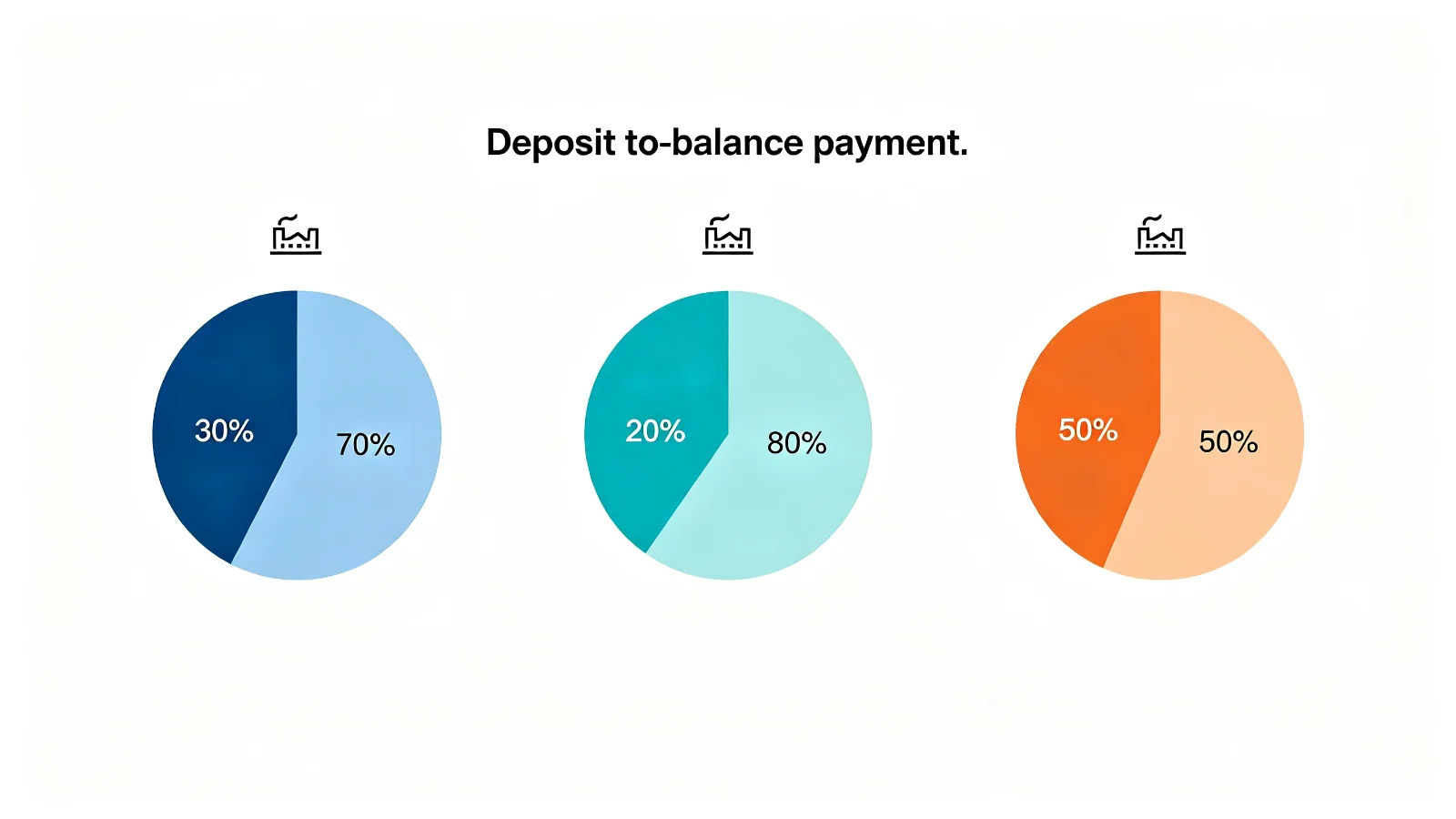
| Deposit Ratio | When It's Standard | Negotiation Difficulty | Buyer Risk |
|---|---|---|---|
| 30% / 70% | Most production orders with established factories | Low (it's the default) | Medium — 30% at risk if factory disappears |
| 20% / 80% | Large orders ($30,000+), repeat customers, or during factory slow season | Medium — requires leverage | Low — only 20% at risk |
| 50% / 50% | Small orders, highly custom designs, new suppliers, or during peak season | High — factory insists on it | High — 50% at risk |
| 0% / 100% | Almost never — only with very long-term trusted relationships | Very high — factory won't agree | Very low — no deposit at risk |
How to Negotiate a Lower Deposit
- Use order size as leverage. A $50,000 order gets more flexibility than a $3,000 order. Factories want large orders and will accept lower deposits to win them.
- Mention competing quotes. "Factory A offered 20% deposit — can you match that?" works more often than you'd think, especially during slow season (March-April, September-October).
- Offer a larger balance payment earlier. "I'll pay 50% after pre-production sample approval instead of after shipment" reduces the factory's cash flow risk and may get you a lower initial deposit.
- Build a relationship first. First order: 30/70. Second order: ask for 25/75. Third order: 20/80. Factories reward repeat customers with better terms.
- Time your order for slow season. Factories are more flexible on deposits in March-April and September-October when order volume is lower.
Payment Nodes Tied to Production Milestones
The safest payment arrangement ties each payment to a verifiable production milestone. This way, you only pay when the factory has completed a specific, inspectable stage of your order — not just when they ask for money.
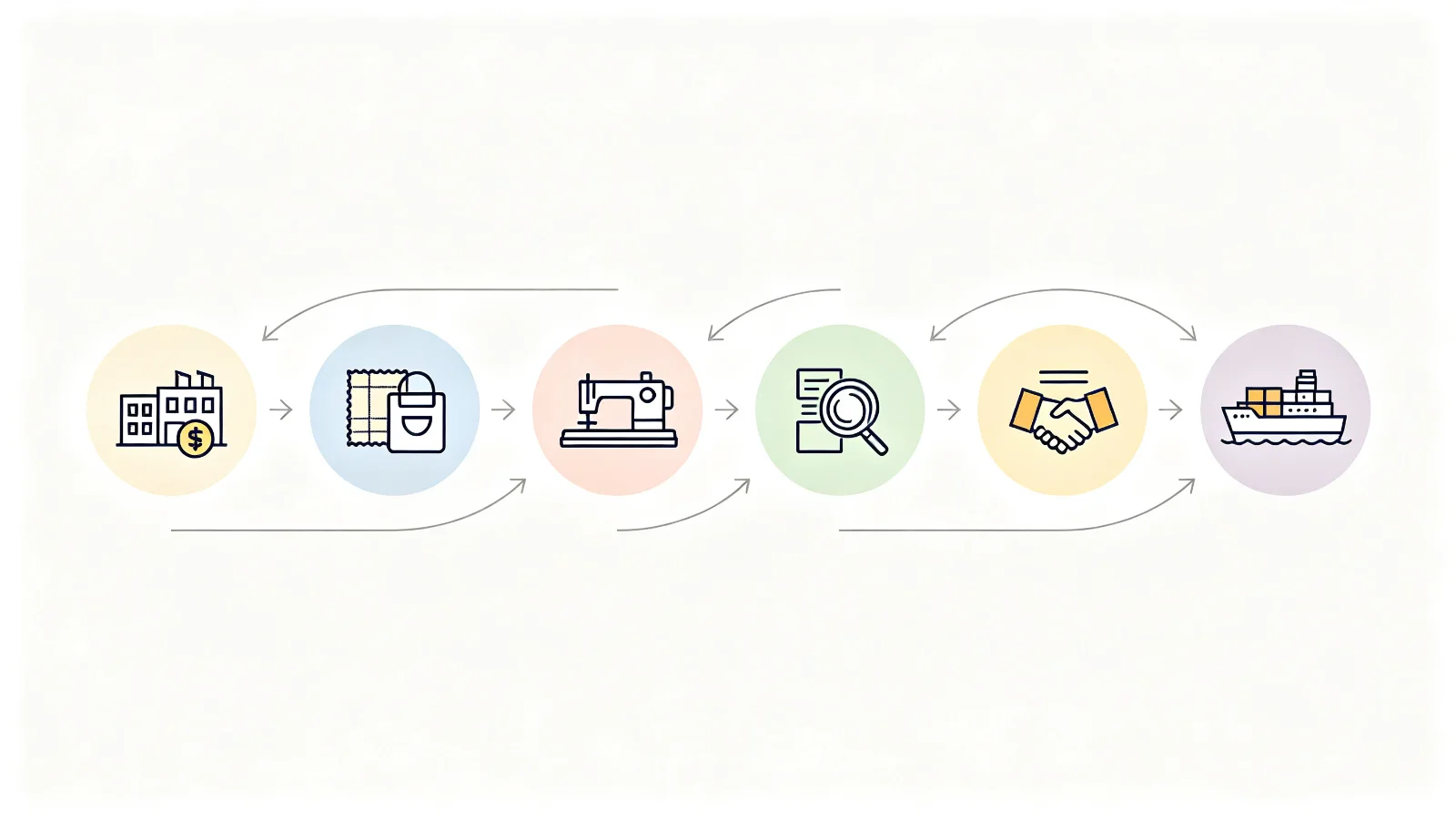
| Milestone | Payment | What to Verify Before Paying | Typical Timing |
|---|---|---|---|
| 1. Order confirmation | 20-30% deposit | Signed PI (proforma invoice), confirmed tech pack, sample approval | Day 0 |
| 2. Material procurement | 0% (included in deposit) | Factory sends photos of purchased fabric, hardware, lining with your color specs | Day 3-10 |
| 3. Pre-production sample | 0% (or additional 10-20% for high-risk orders) | Receive and approve pre-production sample in hand — photos are not enough | Day 10-20 |
| 4. Production (mid-point) | 0% | Factory sends photos/videos of production line with your bags being made | Day 20-35 |
| 5. Pre-shipment inspection | 0% | Third-party inspection report (AQL 2.5) or your own inspection — pass before balance | Day 35-45 |
| 6. Balance payment | 70-80% balance | Copy of bill of lading (B/L) confirming goods are on the ship | Day 40-50 |
| 7. Document release | 0% (already paid) | Receive original B/L, commercial invoice, packing list, certificate of origin | Day 45-55 |
Understanding Chinese Factory Payment Culture
Many payment conflicts between Western buyers and Chinese factories stem from cultural misunderstandings about how money works in Chinese manufacturing. Understanding the factory's perspective helps you negotiate better terms and avoid unnecessary conflict.
12 Scam Red Flags: When to Walk Away
Scammers in the bag manufacturing space are sophisticated. They create professional-looking Alibaba listings, steal real factory photos, communicate fluently in English, and even send samples (ordered from a real factory and reshipped to you). But there are always red flags — if you see any of these, stop and verify before sending money.
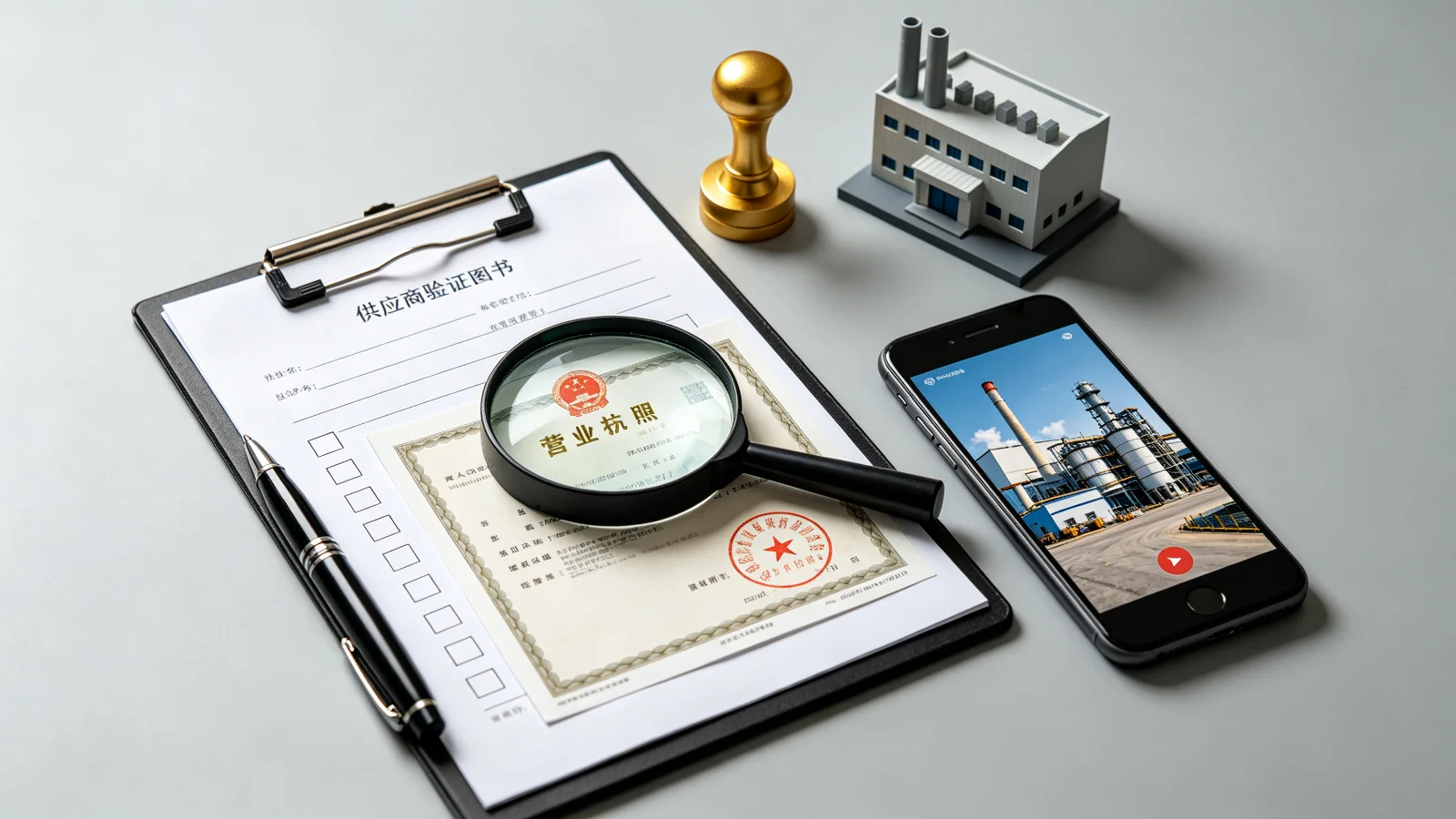
Supplier Verification Checklist: 8 Steps Before Paying
Before sending any money to a new supplier, complete these 8 verification steps. Total time: 30-60 minutes. Total cost: $0-$100. This is the highest ROI activity in bag sourcing — it can save you from losing thousands of dollars to a scammer.
What to Do When Something Goes Wrong
Even with verification and safe payment terms, things can go wrong: quality issues, delayed shipment, missing goods, or in the worst case, the supplier disappears. Here's what to do at each escalation level.
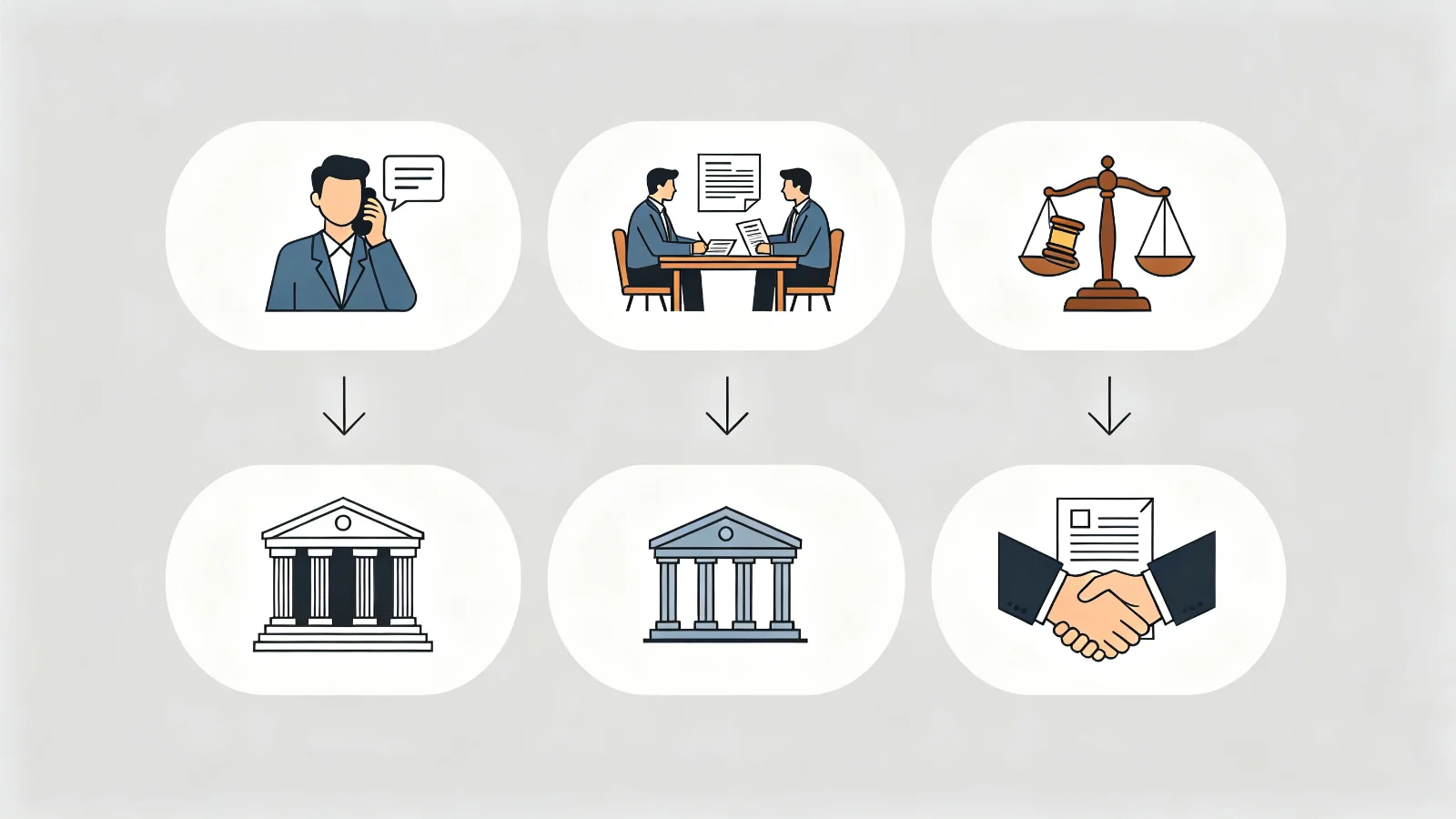
Level 1: Direct Communication (First 48 Hours)
Most issues are resolved through direct communication. Contact the supplier via email, WeChat, or WhatsApp, clearly describe the problem with photos/videos, and propose a solution (rework, discount, replacement, or partial refund). Be firm but professional — Chinese business culture values "face" (mianzi), and public humiliation or aggressive language will make the supplier defensive and less likely to cooperate.
Level 2: Formal Written Complaint (Week 1-2)
If direct communication doesn't resolve the issue, send a formal written complaint via email (not WeChat — email creates a better paper trail). Reference the PI (proforma invoice), order number, and specific contract terms. Attach evidence: photos, videos, inspection reports, shipping documents. State your desired resolution clearly and give a deadline (7-14 days) for response.
Level 3: Platform Dispute (If Applicable)
If you paid through Alibaba Trade Assurance, open a dispute on the platform. Alibaba will mediate between you and the supplier. You'll need to provide evidence (photos, videos, inspection reports, communication records). The dispute process typically takes 1-4 months. If you paid via PayPal, file a dispute within 180 days of payment — PayPal often sides with buyers in "significantly not as described" cases.
Level 4: Arbitration (For Large Orders)
For orders over $10,000 where direct negotiation and platform disputes have failed, consider arbitration. The China International Economic and Trade Arbitration Commission (CIETAC) handles international trade disputes. Arbitration is faster than litigation (6-12 months vs 2-3 years) and the award is enforceable in China under the New York Convention. Cost: $2,000-$5,000 in arbitration fees plus legal representation.
Level 5: Litigation (Last Resort)
Litigation in Chinese courts is the last resort and is rarely cost-effective for orders under $50,000. Chinese courts can take 2-3 years, require a Chinese lawyer (¥50,000-¥200,000+), and even if you win, enforcing the judgment against a factory that has moved or closed can be impossible. Only pursue litigation for very large orders where the amount justifies the time and cost.
Safe Payment Strategy by Order Size
The right payment method and terms depend heavily on your order size. Here's a practical guide for every order tier, from sample orders to large production runs.
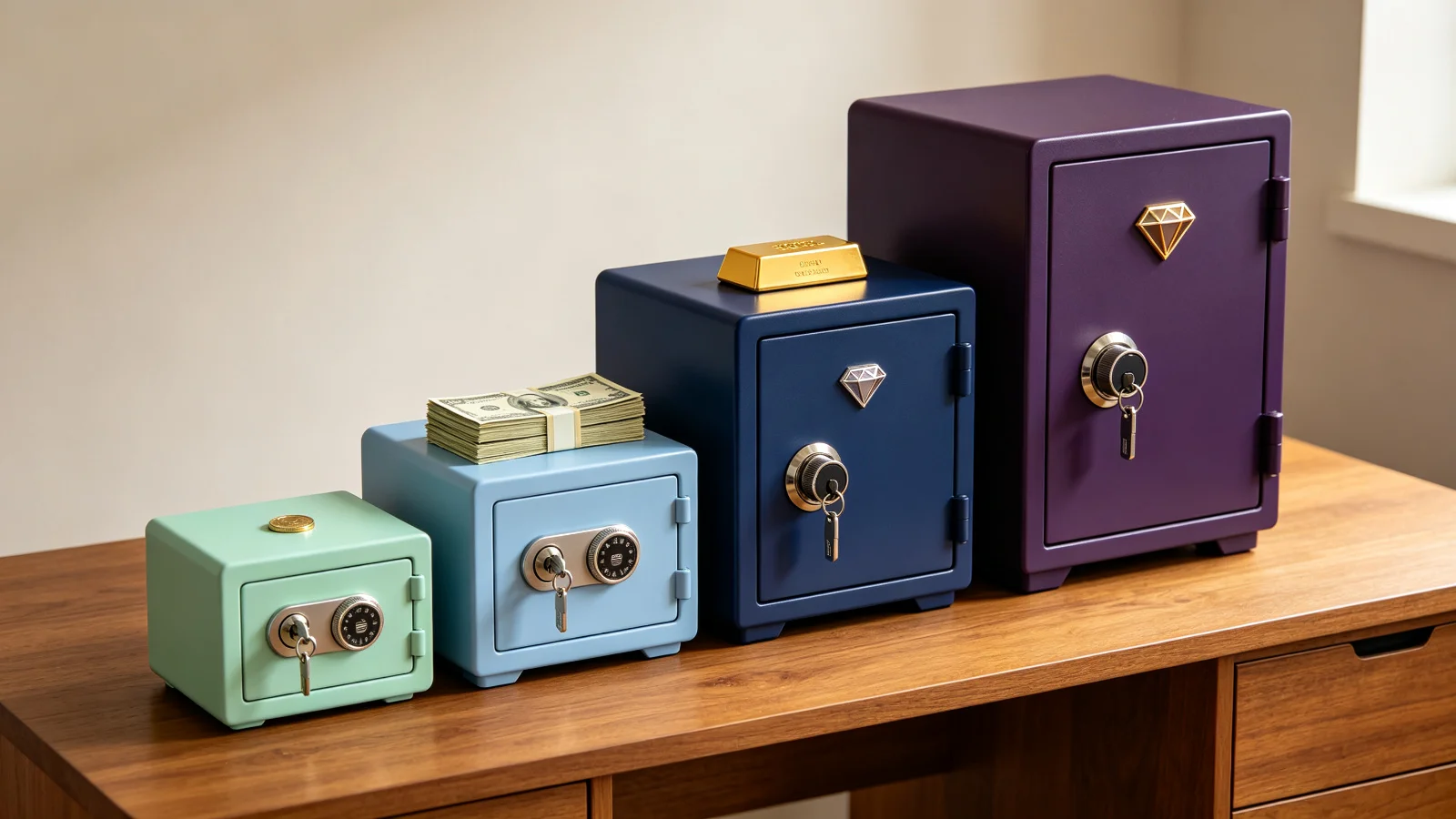
| Order Size | Recommended Payment | Deposit | Inspection | Key Risk Control |
|---|---|---|---|---|
| Under $500 (Samples) | PayPal | 100% (it's a sample) | None — inspect on arrival | PayPal buyer protection (180 days) |
| $500 - $5,000 (Small production) | Alibaba Trade Assurance | 30-50% | Self-inspect photos | Platform holds payment until delivery |
| $5,000 - $20,000 (Medium production) | T/T 30% deposit + 70% against B/L copy | 30% | Third-party pre-shipment ($150-$300) | Verify factory + inspect before balance |
| $20,000 - $50,000 (Large production) | T/T 20% deposit + 80% against B/L copy | 20% (negotiable) | Third-party during + pre-shipment | Lower deposit + dual inspection + signed contract |
| Over $50,000 (Very large) | Irrevocable L/C at sight, or T/T 20% + L/C 80% | 0-20% | Third-party during + pre-shipment + loading | Bank guarantee + full inspection suite + legal contract |
2026 Payment Trends: What's Changing
The payment landscape for Chinese manufacturing is evolving faster than at any point in the last decade. Here are the key trends affecting bag factory payments in 2026.

CIPS (Cross-Border Interbank Payment System) Growth
China's CIPS system, launched in 2015 as an alternative to SWIFT, has grown to handle over $50 trillion in annual transactions (2025 data). More Chinese banks and factories are offering CIPS as a payment channel, especially for buyers in Asia, the Middle East, and Africa. CIPS transactions are faster (same-day vs 1-3 days for SWIFT) and have lower fees ($5-$15 vs $20-$50 for SWIFT). For bag buyers, this means faster payment processing and lower bank fees — ask your factory if they accept CIPS payments.
Stablecoin Payments Going Mainstream
USDT (Tether) on the TRC20 network has become a de facto payment method for small and medium Chinese factories that struggle with international bank access. By 2026, an estimated 15-20% of small Chinese export factories accept USDT payments. The advantages are clear: $1 transaction fee, instant settlement, no bank account required, no currency conversion. The risks remain: irreversible transactions, no buyer protection, and regulatory uncertainty. If you use stablecoins, only use them with verified, repeat suppliers — never for a first order.
Supply Chain Finance Platforms
Platforms like PingPong, WorldFirst, and Airwallex are offering supply chain finance solutions that let buyers extend payment terms (net 30, net 60) while the factory gets paid immediately. The platform takes a fee (1-3% of order value) but solves the cash flow problem for both parties. This is especially valuable for bag brands that need to preserve cash flow for marketing and inventory while ensuring factories get paid on time. Expect more factories to offer these platforms as a payment option in 2026.
Digital Yuan (e-CNY) for Cross-Border Trade
China's digital yuan (e-CNY) is being piloted for cross-border trade payments through the mBridge project (a joint initiative of China, Hong Kong, Thailand, and UAE central banks). While not yet widely available for Western buyers, e-CNY could eventually enable instant, low-fee cross-border payments without SWIFT intermediaries. For now, this is a trend to watch rather than a practical payment option.
AI-Powered Fraud Detection
Banks and payment platforms are deploying AI systems to detect fraudulent transactions in real-time. If you send a T/T to a new Chinese factory, your bank may flag the transaction for review if the AI detects patterns associated with fraud (new payee, large amount, high-risk country). This can delay payments by 1-5 business days. To avoid delays, notify your bank in advance about large international payments and provide supporting documents (PI, contract, supplier website).
Safe Payment Action Checklist
Before you send any payment to a bag factory, go through this checklist. If you can't check every box, don't send the money — go back and complete the missing steps.
Ready to Manufacture Your Bags Safely?
At MerrisBags, we've handled payment for 500+ bag orders with zero payment fraud. We use 30% T/T deposit + 70% balance against B/L copy, welcome video factory tours, and provide full business license verification. Get a free quote and sample today — no payment required until you approve the sample.
Get a Free Quote & Sample View Our ServicesFrequently Asked Questions
What is the standard payment term for Chinese bag factories?
The standard is 30% T/T deposit upon order confirmation, 70% balance against copy of bill of lading (B/L) before shipment. This means you pay the deposit to start production, and the balance when the goods are on the ship but before the original documents are released. For new suppliers, some factories may ask for 50% deposit. For large or repeat orders, you can often negotiate 20% deposit.
Is it safe to pay a Chinese bag factory by T/T?
T/T is safe if you've verified the supplier (business license, video call, sample) and use standard terms (30% deposit + 70% against B/L copy). The risk is the deposit (30%) — if the factory disappears, you lose that. To minimize risk, verify the factory before paying, never pay 100% upfront, and never pay to a personal bank account. For orders under $5,000 with a new supplier, use Alibaba Trade Assurance instead of T/T.
How do I verify a Chinese bag factory before paying?
Complete these 8 steps: (1) check business license on gsxt.gov.cn, (2) video call the factory and ask to see the production line, (3) verify bank account name matches company name, (4) check email domain (company domain > free email), (5) order and approve a physical sample, (6) search for complaints online, (7) use Trade Assurance for first order, (8) start with a small order. Total time: 30-60 minutes. This prevents 99% of payment fraud.
What should I do if a factory asks for Western Union?
Walk away. Any factory that asks for Western Union or MoneyGram payment is either a scammer or operating so far outside normal business practices that you shouldn't work with them. Legitimate Chinese factories have company bank accounts and accept T/T (telegraphic transfer). This is the single most reliable scam indicator in bag sourcing — don't make exceptions, even if the price is very low.
Can I pay a Chinese bag factory with PayPal?
For sample orders under $500, yes — PayPal's buyer protection (180 days) makes it the safest option for small payments. For production orders, most factories refuse PayPal because of chargeback risk. If a factory does accept PayPal for production, they'll add 5-10% to the unit price to cover fees and risk. For production orders with verified suppliers, T/T is almost always cheaper and is the industry standard.
When should I use a letter of credit (L/C) for bag manufacturing?
Use an L/C for orders over $50,000 with a new supplier, or when your company's finance department requires bank-guaranteed payment. L/Cs provide the highest level of protection (the bank verifies documents before paying) but cost $500-$1,500 in fees and take 5-10 days to set up. For orders under $20,000, L/C fees eat into margin and T/T with proper verification is more practical. Not all factories can handle L/Cs — they need a bank relationship for trade documentation.
What percentage deposit should I pay a bag factory?
Standard is 30% deposit / 70% balance. For small orders or highly custom designs, factories may ask for 50%. For large orders ($30,000+) or repeat customers, you can often negotiate 20%. Never pay 100% upfront to a new supplier — this eliminates all your leverage. The deposit covers material procurement (fabric, hardware, lining), which the factory must pay for before production starts. A 30% deposit is reasonable and standard industry practice.
How do I get my money back if a Chinese bag factory scams me?
Recovery depends on the payment method: PayPal disputes (180-day window, high success rate), Alibaba Trade Assurance (platform mediation, 1-4 months), T/T (very difficult — contact your bank immediately to attempt recall, but success rate is low), Western Union (almost impossible). For large orders ($10,000+), consider CIETAC arbitration (6-12 months, $2,000-$5,000). Prevention is far more effective than recovery — verify before paying, use safe payment methods, and never skip the verification checklist.