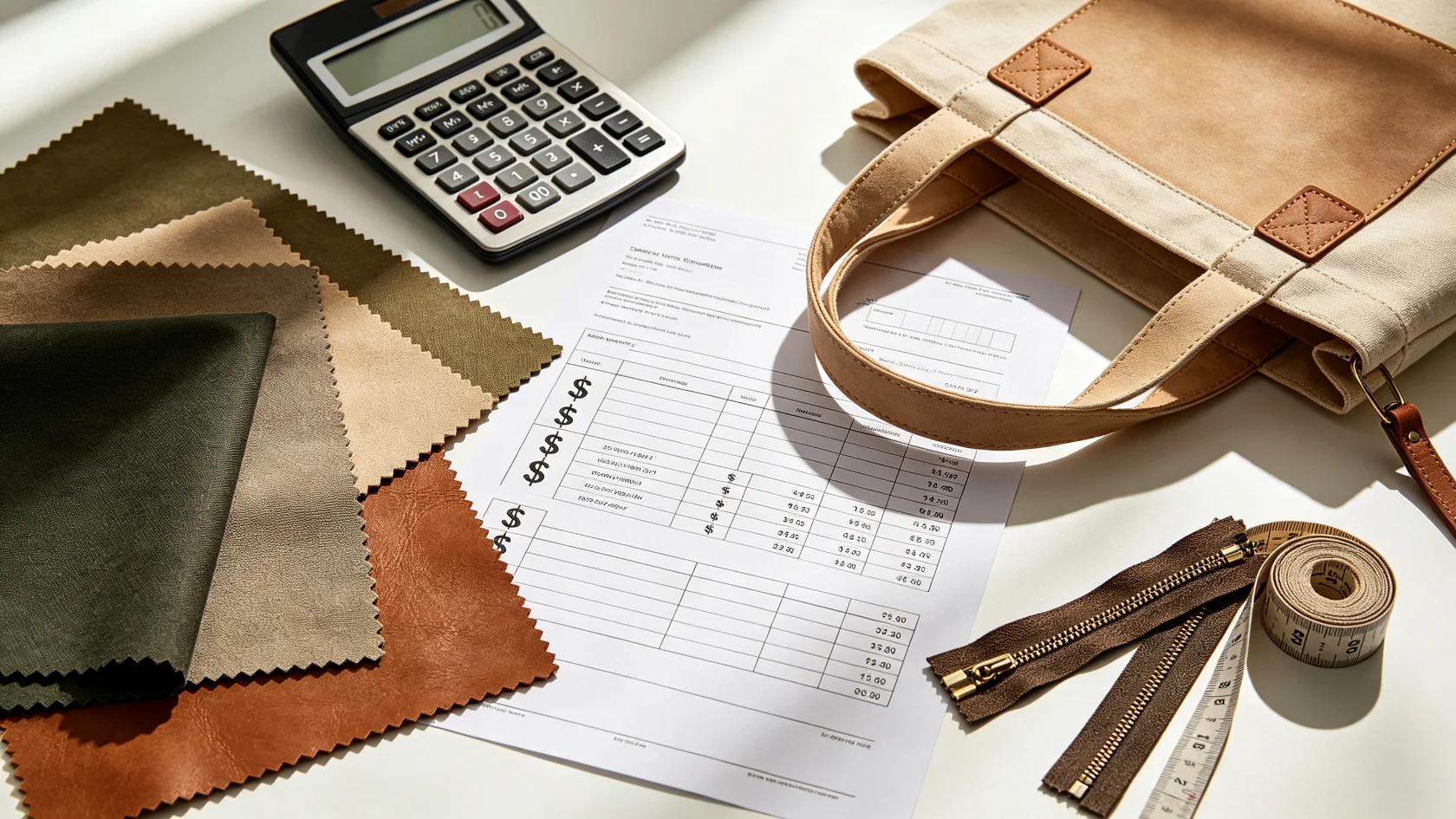
If you've ever requested a bag quotation and received three wildly different numbers from three factories, you're not alone. The problem isn't that factories are dishonest — it's that "custom bag" covers everything from a $1.50 non-woven giveaway to a $40 leather briefcase, and most buyers don't know which levers actually move the price.
We've put together this guide based on actual costing data from our Dongguan factory floor. No ranges so wide they're useless. No "contact us for pricing" cop-outs. Just real numbers, the factors that drive them, and the fees that show up on your invoice after you've already placed the order.
2026 Custom Bag Price Reference (FOB China)
These are typical ex-factory prices for orders of 1,000 pieces per style/color, standard construction, in-stock materials. Your exact quote will vary based on dimensions, material grade, hardware, branding, and packaging.
| Bag Type | Typical Material | 500 pcs | 1,000 pcs | 3,000 pcs | 5,000+ pcs |
|---|---|---|---|---|---|
| Non-woven tote | 80g non-woven PP | $0.65–$1.10 | $0.50–$0.85 | $0.40–$0.65 | $0.35–$0.55 |
| Canvas tote (8oz) | Cotton canvas | $2.20–$3.80 | $1.80–$3.00 | $1.40–$2.40 | $1.20–$2.00 |
| Polyester tote (600D) | 600D polyester + PU | $2.50–$4.20 | $2.00–$3.50 | $1.60–$2.80 | $1.40–$2.40 |
| Cosmetic pouch | Polyester / PVC | $1.50–$3.00 | $1.20–$2.50 | $0.95–$1.90 | $0.80–$1.60 |
| Nylon backpack | 420D/600D nylon | $5.50–$9.50 | $4.50–$8.00 | $3.80–$6.50 | $3.20–$5.50 |
| Polyester backpack | 600D/900D polyester | $4.80–$8.50 | $4.00–$7.00 | $3.30–$5.80 | $2.90–$5.00 |
| Duffel bag | 600D polyester | $5.00–$9.00 | $4.20–$7.50 | $3.50–$6.20 | $3.00–$5.30 |
| Cooler bag | Polyester + EPE foam | $3.80–$6.50 | $3.20–$5.50 | $2.60–$4.50 | $2.20–$3.80 |
| PU leather wallet | PU leather + card slots | $2.80–$5.00 | $2.30–$4.20 | $1.90–$3.50 | $1.60–$3.00 |
| PU leather handbag | PU leather + hardware | $6.50–$12.00 | $5.50–$10.00 | $4.50–$8.50 | $4.00–$7.50 |
| Genuine leather bag | Top-grain cowhide | $15.00–$28.00 | $12.00–$24.00 | $10.00–$20.00 | $9.00–$18.00 |
Where Does the Money Actually Go?
Ever wondered why a bag that uses $1.50 worth of fabric costs $4.00? Here's the typical cost structure for a mid-range custom bag (polyester tote or small backpack) at 1,000 pieces:
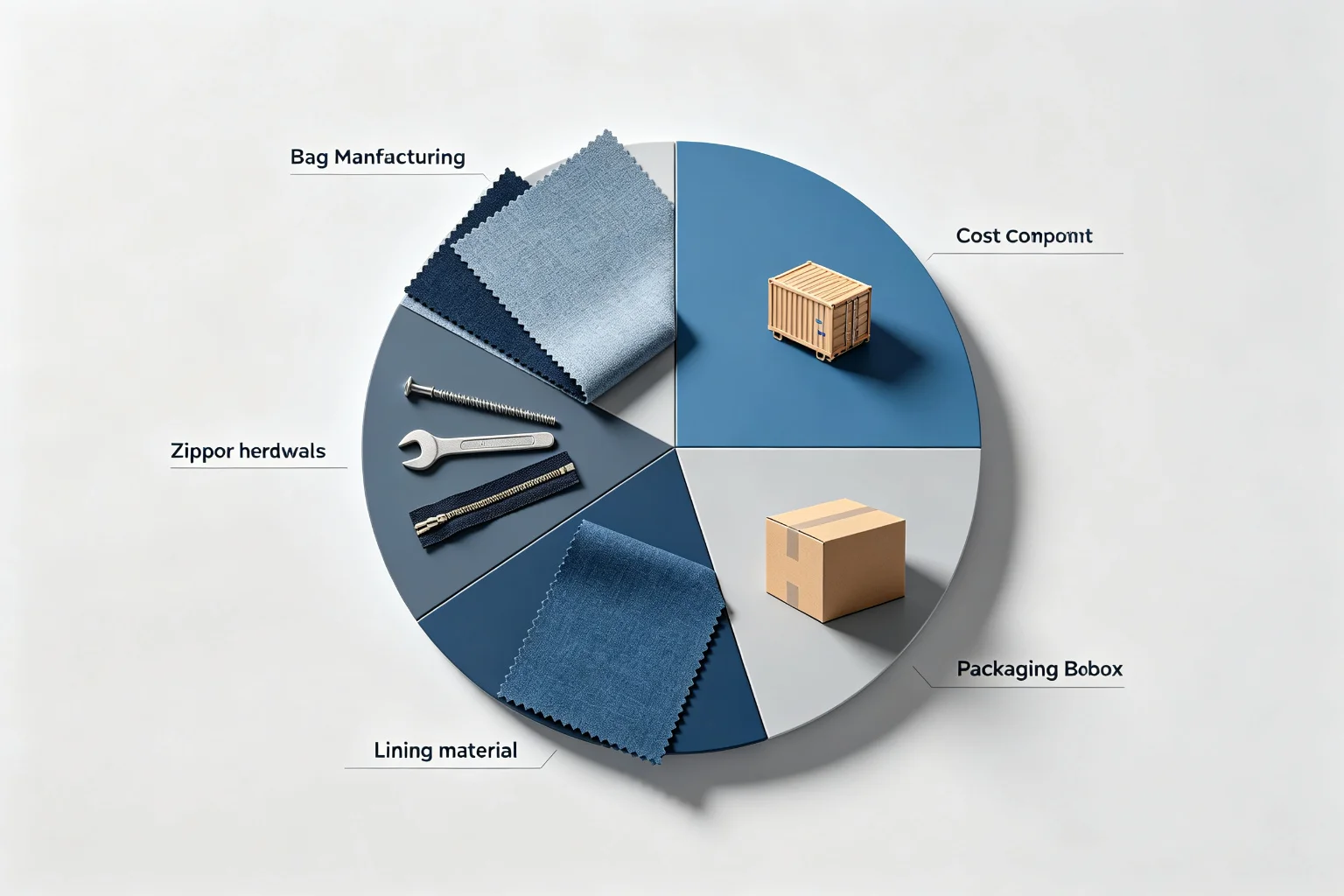
Fabric: The Single Biggest Cost Driver
Shell fabric typically accounts for 25–35% of the total unit cost, and it's where most buyers overpay or under-specify. A 600D polyester with PU coating costs roughly $1.80–$2.50 per yard. A 420D nylon runs $2.50–$3.50 per yard. Full-grain cowhide? $8–$15 per square foot, and you lose 20–30% to cutting waste.
The trap: upgrading from 600D to 900D polyester adds 15–20% to fabric cost but most customers can't tell the difference by feel. Unless your bag genuinely needs the extra abrasion resistance (heavy-duty work bags, outdoor gear), 600D is the sweet spot for price-to-durability.
For a deeper dive into material properties and pricing, see our complete bag materials guide.
Labor: It's Not as Cheap as You Think
Dongguan garment and bag factory wages have roughly doubled since 2018. A skilled sewing machine operator now earns $500–$700 per month (plus room, board, and social insurance that add another 30–40%). A simple tote takes 12–18 minutes to cut and sew. A structured backpack with multiple compartments? 45–75 minutes of labor. Do the math and labor is rarely the bargain outsiders assume.
This is also why construction complexity matters more than most buyers realize. Adding one internal zipper pocket can add $0.30–$0.60 per unit. A gusseted bottom? $0.20–$0.40. Padded shoulder straps with mesh backing? $0.50–$1.00. These don't sound like much individually, but across five design details you've added $2.00 per bag.
How Quantity Changes the Per-Unit Price
The most powerful pricing lever you control is order quantity. Here's why the per-unit price drops so sharply between 500 and 3,000 pieces:
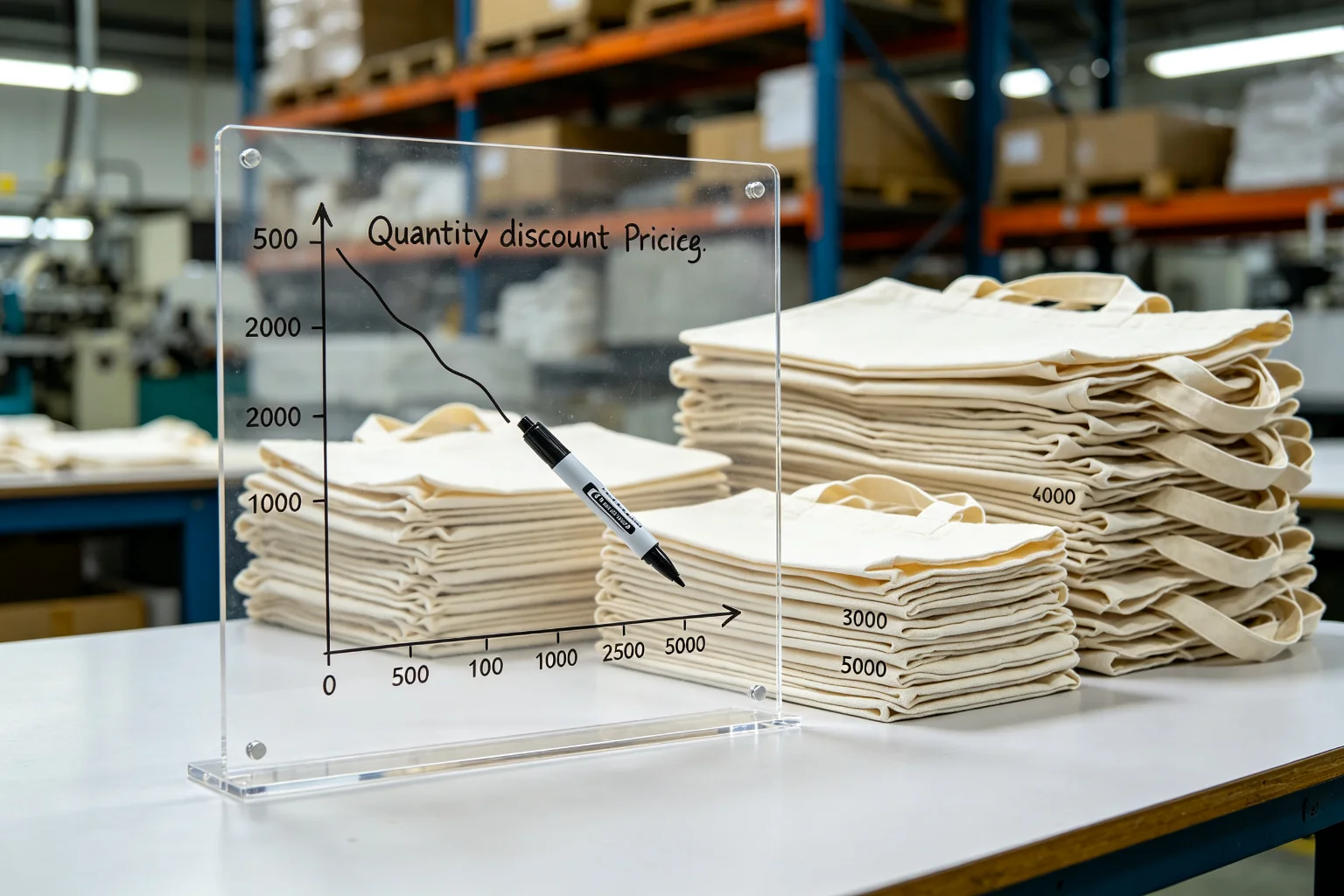
Every order has fixed costs that don't change regardless of quantity: pattern making ($50–$150), sample development, production setup, material sourcing administration, and quality inspection planning. At 500 pieces, these fixed costs might add $0.60 per unit. At 3,000 pieces, the same fixed costs spread to $0.10 per unit. That's a $0.50 difference before you even get to material bulk discounts.
| Quantity Tier | What Changes | Typical Unit Price Impact |
|---|---|---|
| 100–300 pcs | Trial/sample order. Factory uses leftover material stock, manual cutting. Price premium 20–40% over standard MOQ. | +25% vs. 1,000 pcs |
| 500 pcs | Standard MOQ for most synthetic fabrics. Automated cutting possible. In-stock colors only. | Baseline |
| 1,000 pcs | Full production line allocation. Custom colors become viable. Better material pricing. | −15 to −20% vs. 500 |
| 3,000 pcs | Bulk material purchasing (5–10% fabric discount). Dedicated production line. Custom hardware feasible. | −30 to −40% vs. 500 |
| 5,000+ pcs | Maximum material discount. Optimized production flow. Smaller incremental savings. | −40 to −50% vs. 500 |
The Hidden Costs Most Buyers Miss
This is the section that saves you money. The per-unit price is only part of what you'll actually pay. Here are the fees that routinely surprise first-time buyers:
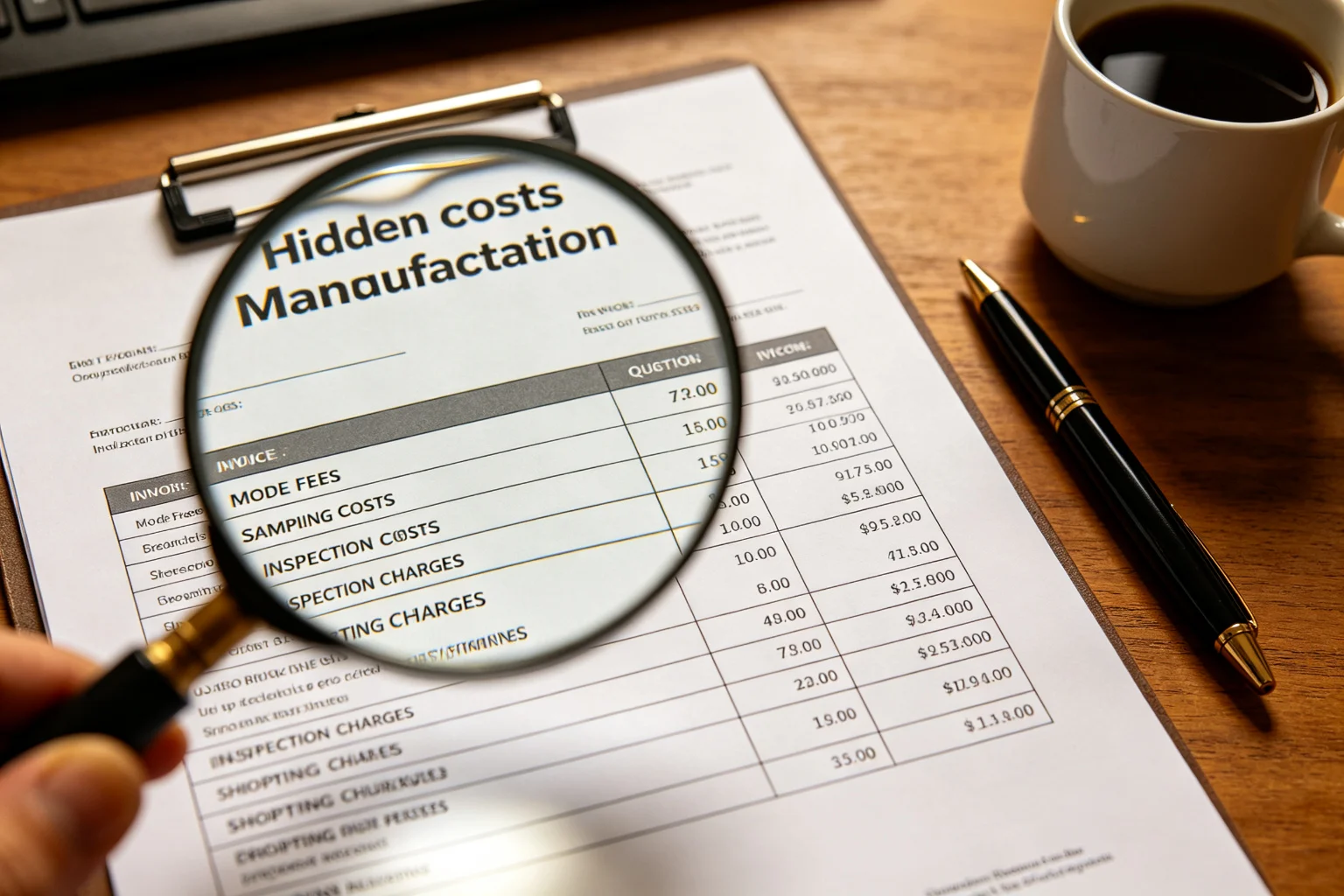
1. Sampling Fees ($30–$150 per sample)
Almost every factory charges for samples, and almost every factory says they'll refund it against a bulk order. The catch: the refund usually only applies if you place the order within 30–60 days and meet their MOQ. If you go through three rounds of samples ($90–$450 total) and then decide to switch factories, that money is gone. Always ask upfront: is the sample fee refundable, against what quantity, and within what timeframe?
2. Mold / Tooling Fees ($50–$500)
If you want custom hardware — a buckle with your logo, a custom-shaped zipper puller, a branded metal label — there's a mold fee. Simple rubber or PVC patches: $50–$150. Metal hardware with custom shape: $200–$500. These are one-time fees, and the mold is yours (ask for it to be marked with your company name). But if you're comparing two factories and one quotes "no mold fee," they're either amortizing it into the unit price or using stock hardware that isn't truly custom.
3. Custom Dyeing Surcharge ($100–$400 per color)
In-stock fabric colors are free. A custom Pantone-matched dye job costs $100–$400 per color per fabric type, and usually requires a 1,000–3,000 piece minimum. If your brand color is a specific shade of teal and you only need 500 bags, expect either a dyeing surcharge or a suggestion to use the closest in-stock color.
4. Third-Party Inspection ($80–$150 per man-day)
You should always get a pre-shipment inspection. Either you fly someone out (expensive), use a service like SGS or Bureau Veritas ($200–$350 per inspection), or ask the factory to provide their own QC report (free but less independent). Budget $150–$300 per inspection for a 500–2,000 piece order. For orders over 5,000 pieces, consider a during-production inspection (DUPRO) as well.
5. Certification & Testing ($200–$1,500+)
Selling into the EU? You may need REACH compliance documentation for fabrics and hardware. California? Prop 65 warnings for certain materials. Children's products? CPSIA testing. These tests are per-material, per-color, and per-production-run. A basic REACH fabric test costs $200–$400. Full CPSIA testing for a children's backpack can run $800–$1,500. If your market requires certification, get the cost confirmed before you place the order — not after production is complete.
6. Rush Production Surcharge (15–30%)
Standard production is 25–35 days. Need it in 15? Expect a 15–30% rush fee. The factory isn't being greedy — they're paying overtime, pulling your order ahead of other customers, and possibly running a night shift. If your timeline is tight, build it into the budget from day one rather than negotiating it as an emergency.
7. Shipping & Duties (often 30–60% of product cost)
FOB price means the goods are loaded onto the ship. From there, ocean freight to the US or EU runs $0.30–$0.80 per bag (depending on volume and fuel surcharges). Customs duties range from 0% (some bags) to 17.6% (leather goods into the US). Add port fees, customs brokerage, and last-mile delivery, and your landed cost could be 30–60% higher than the FOB unit price. Always calculate landed cost per unit, not factory price per unit.
What's Driving Prices in 2026
If you sourced bags in 2023 or earlier, the 2026 price landscape has shifted. Here's what's changed:
How to Lower Cost Without Killing Quality
Every buyer wants a lower price. The question is whether you're cutting cost or cutting corners. Here are strategies that reduce price without your customer noticing:
Consolidate Colors and Styles
Ordering 500 pieces each in 4 colors = 2,000 total but 4 separate setups. Ordering 2,000 pieces in 1 color = one setup, one fabric dye lot, one production run, and a 15–25% lower unit price. If you need multiple colors for retail, start with 1–2 best-sellers and add colors on reorder.
Use In-Stock Materials
Custom dyeing adds $100–$400 and 7–14 days. Most factories carry 20–40 in-stock colors in popular fabrics. Ask for a physical swatch card — you might find a color close enough to your brand color that the difference is invisible on a retail shelf.
Simplify Construction
Every pocket, zipper, gusset, and reinforcement adds labor time. A backpack with 3 external pockets costs $1.00–$2.00 more than the same backpack with 1 pocket. Design for the features your customer actually uses, not the ones that look impressive in a spec sheet.
Standardize Hardware
Custom buckles and zipper pullers look great but cost $0.30–$1.00 more per unit plus mold fees. Stock hardware in a matching finish (nickel, gunmetal, matte black) achieves 90% of the branding effect at a fraction of the cost. Save custom hardware for your flagship SKU.
Bundle Orders with Other Brands
If you're a startup ordering 300 pieces, you're paying a premium. Some factories will combine your order with another brand's similar product to hit material MOQ — you get the 1,000-piece material price even though you only take 300. It's not common, but it's worth asking, especially if your product uses a standard fabric.
Negotiate Payment Terms, Not Just Price
A 3% discount on unit price saves you $150 on a $5,000 order. Net-30 payment terms instead of 30% deposit / 70% before shipment improves your cash flow by $3,500 for 30+ days. For growing brands, better terms are often worth more than a small unit price reduction.
What to Ask Before You Accept a Quotation
A quotation is only useful if you know what's included. Send these questions with every RFQ:
- Is this FOB, EXW, or DDP?
- What fabric weight and coating is included?
- What zipper brand is quoted (YKK or generic)?
- Are sample fees refundable against bulk order?
- Is there a mold fee for custom hardware?
- Is custom dyeing included or extra?
- What's the production lead time after sample approval?
- What's the payment term (deposit % and balance timing)?
- Is there a charge for revisions after the first sample?
- What packaging is included (polybag only, or hang tag + box)?
- Are there minimums for custom labels or woven tags?
- What's the defect tolerance / AQL level?
- Who pays for replacement of defective units?
- Is there a rush fee if production needs to speed up?
- Are there any market-specific compliance costs?
- What's the reorder lead time for the same product?
Real Example: A 1,000-Piece Custom Tote
Let's put this all together. Here's a realistic cost stack for 1,000 custom 600D polyester tote bags, 38×42cm, with one internal pocket, custom screen-printed logo, black polybag packaging, FOB Shenzhen:
| Cost Component | Amount | Per Unit |
|---|---|---|
| Shell fabric (600D polyester + PU coating) | $1,050 | $1.05 |
| Lining (210T polyester taffeta) | $280 | $0.28 |
| Webbing handles (2× 60cm) | $220 | $0.22 |
| Zipper (top closure, #5 nylon) | $320 | $0.32 |
| Thread, labels, interfacing | $150 | $0.15 |
| Labor (cutting + sewing + finishing) | $850 | $0.85 |
| Screen printing (1 color, 1 location) | $180 | $0.18 |
| Packaging (polybag + carton) | $120 | $0.12 |
| Factory overhead + margin | $430 | $0.43 |
| Total FOB | $3,600 | $3.60 |
| Sampling (1 round, refundable) | $50 | — |
| Pre-shipment inspection | $180 | $0.18 |
| Ocean freight (to US West Coast) | $350 | $0.35 |
| US customs duty (17.6% for synthetic bags) | $634 | $0.63 |
| Customs brokerage + port fees | $120 | $0.12 |
| Landed cost (US) | $4,934 | $4.93 |
So a bag quoted at $3.60 FOB actually costs you $4.93 landed. If you retail it at $19.99, that's a 75% gross margin — healthy but not the 90% some "manufacturer direct" marketing implies. If you wholesale it at $9.00, your gross margin is 45% before your own operating expenses.
Frequently Asked Questions
How much does it cost to manufacture a custom bag?
Custom bag manufacturing costs range from $1.20 per unit for a simple cosmetic pouch at 3,000 pieces to $25+ per unit for a full-grain leather backpack at 500 pieces. Most mid-range custom bags (polyester totes, nylon backpacks, PU wallets) fall between $2.50 and $8.00 per unit at standard MOQ (500–1,000 pieces). These are ex-factory (FOB China) prices and exclude shipping, duties, and taxes.
What is the minimum order quantity for custom bags?
Standard MOQ for custom bags is 500 pieces per style/color for synthetic fabrics (polyester, nylon, PVC) and 300 pieces for canvas/cotton. Custom-dyed fabrics and custom hardware typically require 1,000–3,000 pieces. Genuine leather minimums start at 200–300 pieces due to higher material costs. Some factories offer 100–200 piece trial orders at a 15–30% price premium.
How much does a bag sample cost?
Bag sampling fees typically range from $30 to $150 per sample, depending on complexity. Simple polyester totes: $30–$50. Structured backpacks with custom hardware: $80–$120. Leather bags: $100–$150. Most factories refund the sample fee against a bulk order of 500+ pieces. Turnaround is 7–15 days for first samples, 5–7 days for revisions.
Are there hidden costs in custom bag manufacturing?
Yes. Common hidden costs include: mold/tooling fees ($50–$300 for custom hardware), custom dyeing surcharges ($100–$300 per color), third-party inspection ($80–$150 per man-day), certification testing ($200–$800 per test), rush production fees (15–30% surcharge), and currency fluctuation risk. Always ask for an all-inclusive quotation and confirm which fees are refundable against bulk orders.
How does order quantity affect unit price?
Unit price drops significantly with quantity. A custom tote that costs $4.20 at 500 pieces may cost $2.80 at 2,000 pieces and $1.90 at 5,000 pieces. The steepest discount happens between 500 and 2,000 pieces (fixed costs like pattern-making and setup are spread over more units). Beyond 5,000 pieces, per-unit savings are smaller (5–10%) and mainly come from material bulk purchasing.
What is the typical lead time for custom bag production?
Standard production lead time is 25–35 days after sample approval for orders under 5,000 pieces. Orders of 5,000–20,000 pieces take 35–50 days. Add 7–15 days for sampling, 5–10 days for sea freight to US/EU, and 3–7 days for air freight. Custom-dyed fabrics or custom hardware can add 7–14 days to the production schedule.
Want a Real Quotation for Your Project?
Send us your bag type, dimensions, target material, quantity, and artwork. We'll reply with a transparent, line-item quotation within 24 hours — no hidden fees, no vague ranges.
Get a Custom Quote Explore Material Options