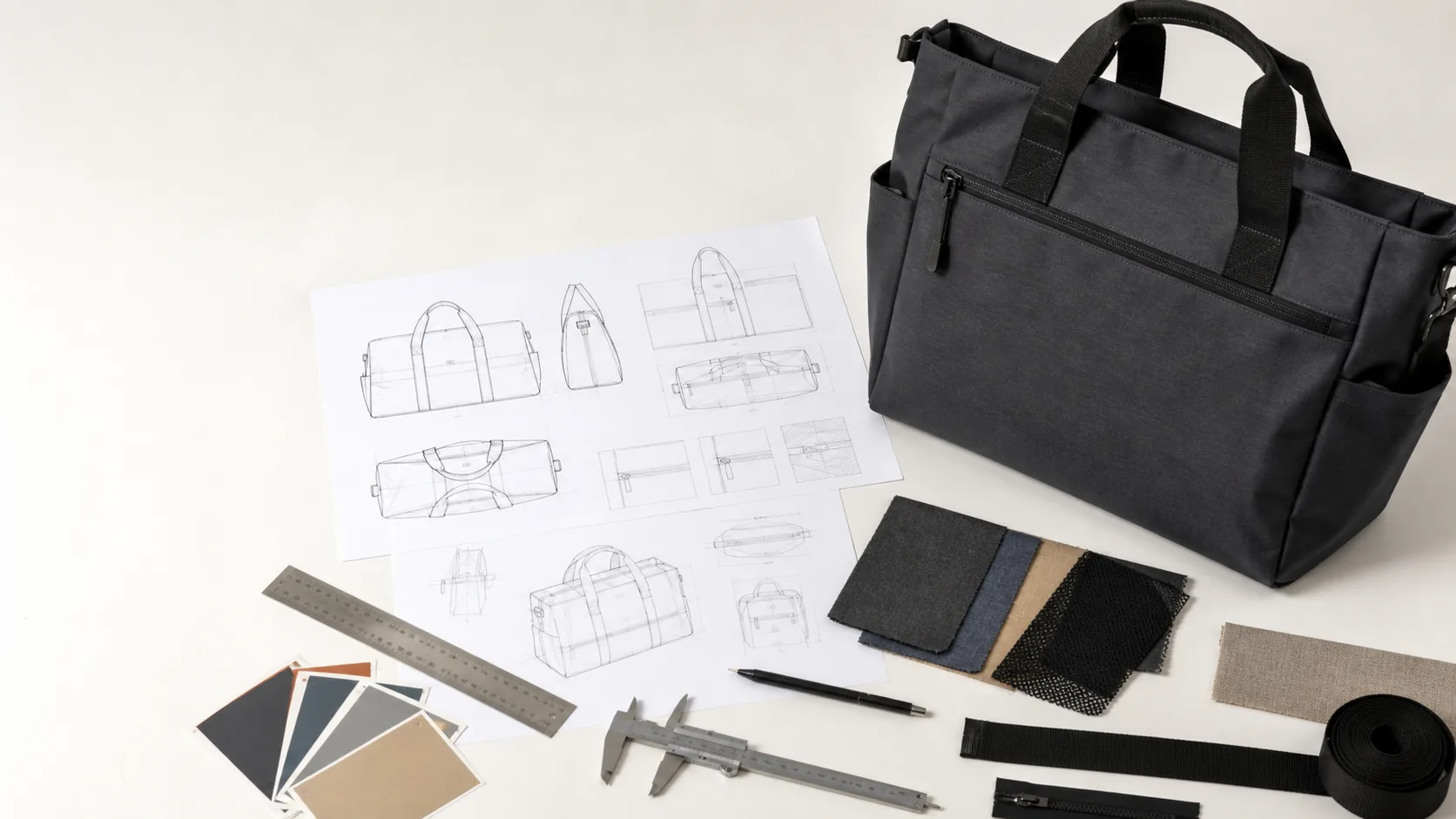
A promising sketch can still produce a disappointing sample when the buyer and factory interpret it differently. “Black nylon tote with a front pocket,” for example, does not define the nylon construction, finished dimensions, pocket opening, lining, reinforcement, zipper, handle drop, logo process or acceptable color reference.
A production-ready specification closes those gaps in a format that can be reviewed, costed and revised. The same principles apply to cosmetic bags, totes, duffels, laptop sleeves, waist bags and backpacks. This guide focuses on the decisions a factory actually needs—not on decorative presentation.
What Is a Bag Tech Pack?
A bag tech pack is the product's working source of truth. It connects design intent with sourcing, sampling, costing, production and inspection. Depending on the project, it may be one organized PDF plus separate artwork files, or a controlled set of drawings, measurement sheets and component schedules.
A good document answers known questions and makes unresolved decisions visible. If the lining material is still open, state “to be confirmed after swatch review.” Hiding uncertainty encourages a supplier to choose silently, making later price and quality disputes more likely.
Why a Tech Pack Matters Before Sampling
The document is not only for the sample maker. Pattern engineers, material buyers, costing teams, cutting operators, sewing supervisors, quality inspectors and packaging teams may all depend on it. A detail mentioned only in an email can easily disappear when information passes between departments.
| Without a controlled tech pack | With a controlled tech pack |
|---|---|
| Factories quote different interpretations of the product. | Suppliers quote against the same dimensions, materials and components. |
| Sample feedback is spread across messages and screenshots. | Every approved change returns to one dated master revision. |
| Bulk production follows memory or an incomplete sample. | The approved sample and specification work together as production references. |
| Quality discussions become subjective. | Critical measurements and functional checks are defined before inspection. |
A clearer specification also improves MOQ and price discussions. Material construction, custom colors, hardware, logo technique and packaging can each change purchasing minimums. Review our custom bag MOQ guide when planning the first production run.
Do You Need One Before Contacting a Supplier?
Not necessarily. A concept sketch, target dimensions, expected quantity, reference photos and a clear use case can support an initial conversation. A capable manufacturer can help identify missing specifications and propose construction options.
However, an early estimate based on incomplete information should not be mistaken for a final production quotation. Before sampling, record enough detail for both sides to evaluate the same product. Before bulk approval, all cost- and quality-critical choices should be confirmed in the master file.
Costing Tech Pack vs. Production Tech Pack
The first version does not need every supplier code, tolerance and carton mark before a factory can respond. For initial costing, focus on the details that materially change consumption, labor and purchased components: finished size, main materials, internal organization, construction complexity, hardware, logo process, packaging and estimated quantity.
A production version must go further. It should replace provisional descriptions with approved swatches or material codes, confirm component dimensions and finishes, lock artwork, record measurement tolerances and identify the pre-production reference. If the quotation was based on a placeholder—such as “standard metal buckle”—the final price should be reconfirmed after the exact buckle is selected.
| Decision status | How to record it | What happens next |
|---|---|---|
| Confirmed | List the approved specification, code, dimension, color and reference. | The factory costs and samples against that choice. |
| Factory to propose | State the required function, target appearance and price level. | The factory submits options for written approval. |
| Buyer to confirm | Mark the open item, owner and decision deadline. | Quotation or sampling remains conditional until confirmed. |
| Alternative permitted | Define which properties must remain equivalent. | Any substitution is documented before use. |
This staged approach avoids two common extremes: delaying supplier contact until every minor detail is perfect, or starting production from a loose mood board. The goal is progressive control—enough information for the current decision, followed by a fully locked production reference.
The 10 Essential Sections
Specify Finished Dimensions and Points of Measure
Use a fixed measurement convention—commonly width × height × depth—and show exactly where each measurement starts and ends. A curved or padded bag can produce different results depending on whether it is empty, filled, compressed or laid flat. A drawing removes ambiguity that a list of numbers cannot.
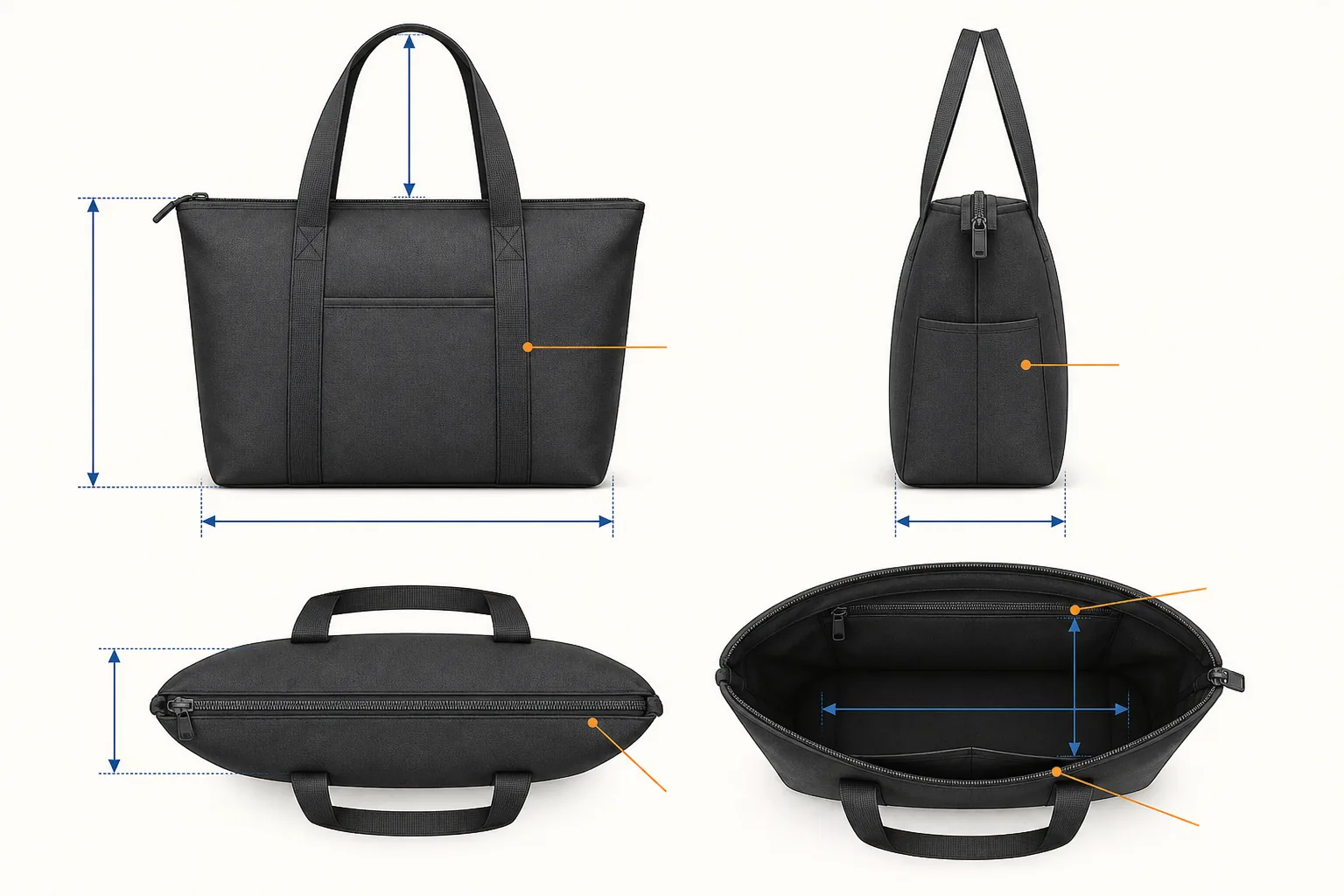
Include strap width and adjustment range, handle drop, zipper opening, pocket position and any internal space required for a device or product. If a laptop sleeve must fit a particular device, specify the usable internal size after foam and lining are assembled—not only the outer panel dimensions.
Tolerances should reflect the construction. Applying ±2 mm to every measurement may look precise but can be unrealistic for padded textile products. Agree tighter tolerances for functional points such as device compartments or fitted inserts, and practical tolerances for larger sewn dimensions.
Build a Usable Bill of Materials
Generic terms such as “nylon,” “canvas” or “good zipper” leave major variables unresolved. Record the material type, construction or weight where known, coating or finish, target color, location, performance expectation and approved reference.
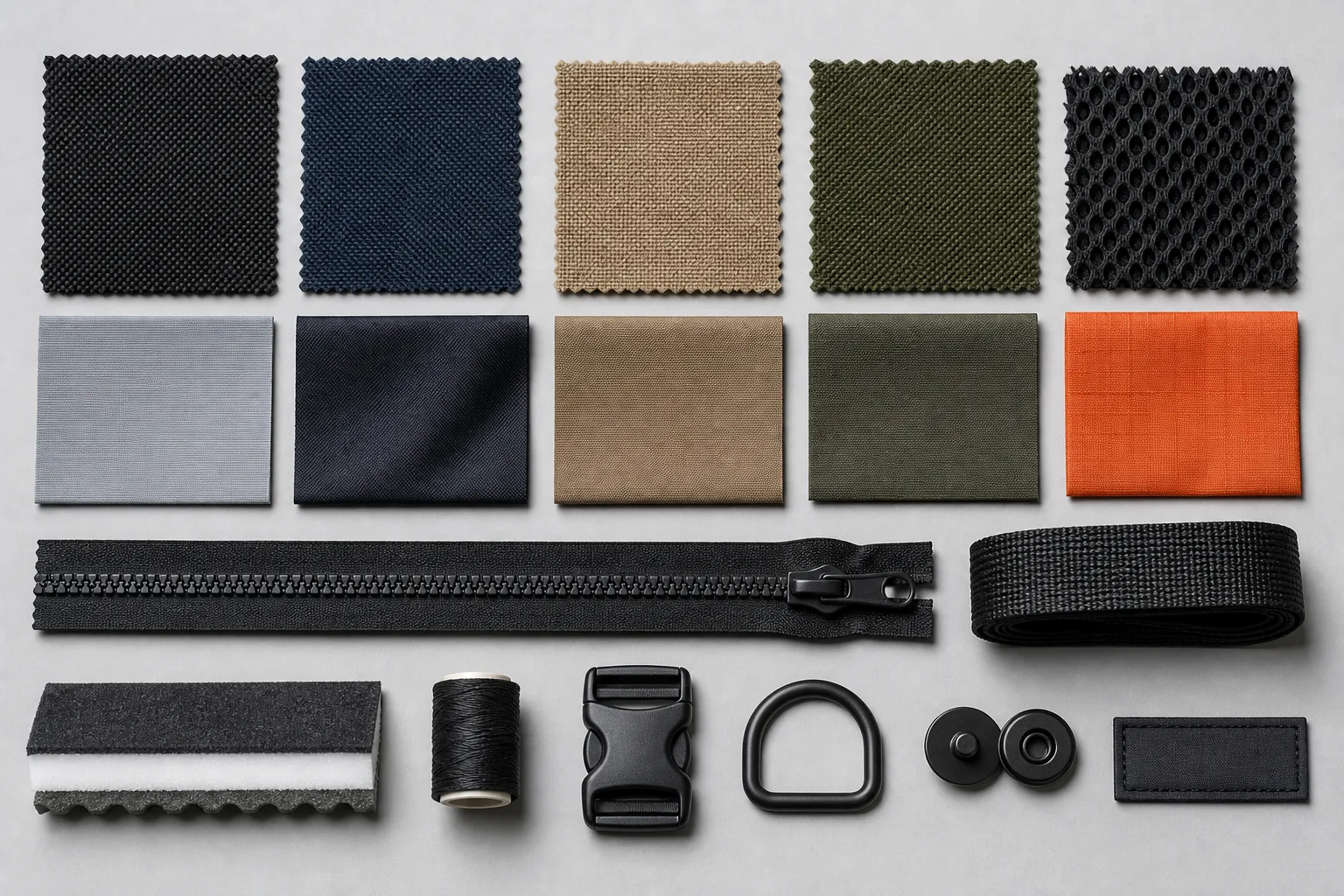
| BOM field | Example of useful information |
|---|---|
| Item and location | Shell body panels; internal zipper pocket; base reinforcement. |
| Material specification | Polyester Oxford, target weight/construction, PU coating, approved navy swatch. |
| Component details | #5 reverse-coil zipper, black tape, matching puller finish, specified opening length. |
| Reference | Supplier code, physical swatch number, approved sample or dated photo reference. |
| Consumption or quantity | Estimated usage per bag or number of pieces per finished unit. |
If the exact material is undecided, explain the intended function—structured retail tote, soft puffer pouch, abrasion-resistant backpack base or insulated cooler lining—and request options for approval. The MerrisBags materials guide provides a starting comparison.
Show How the Bag Is Constructed
A drawing shows what the bag looks like; construction callouts explain how it is assembled. Mark seam type, binding, folded edges, zipper installation, lining attachment, foam placement and reinforcement at stress points. Detail views are useful wherever several layers meet.
For handles and shoulder straps, specify webbing width, attachment length, reinforcement pattern and any load expectation. For structured bags, identify board, foam or other support layers. For waterproof or cooler products, distinguish water-resistant fabric from seam construction designed to control leakage.
Treat Branding as a Manufacturing Detail
Place the logo on the drawing and specify its finished width and height, distance from fixed seams, color, orientation and application method. Provide vector artwork separately. Embroidery, screen printing, heat transfer, woven labels, rubber patches, leather patches, metal plates and embossing each create different minimum detail sizes, costs and material constraints.

State whether logo dimensions refer to the artwork boundary or the finished badge. If the design repeats across a panel, include repeat size, artwork orientation, bleed and pattern alignment expectations. See the custom bag logo craft guide for technique-specific tradeoffs.
Include Packaging, Labels and Market Requirements
Packaging affects cost, MOQ, product shape and shipping volume, so it should not be left until production is complete. Define how the bag is folded, which straps are secured, whether tissue or inserts maintain shape, the type and size of protective bag, label positions and master-carton quantity.
Add barcode data, hang-tag artwork, carton marks, warning labels and destination-specific information supplied by your compliance team. If testing is required, identify the product, material or performance characteristic to be tested and when approval is needed. Avoid writing “must meet all standards”; tell the supplier which market and requirement apply to the project.
Define Tolerances and Quality Checks
A tech pack should identify what matters most to product function and customer perception. Critical dimensions may include device fit, strap range, zipper opening and pocket location. Functional checks may cover zipper operation, buckle engagement, strap security, load performance or leak resistance where applicable.
Appearance requirements can address shade consistency, logo position, stitch balance, wrinkles, marks and symmetry. The specification should not try to replace an inspection plan, but it should give inspectors an approved reference and measurable requirements. Link it to the agreed sampling and quality-control process.
Use Reviewable Files and Control Revisions
- Export the complete document as a clearly named PDF for review and approval.
- Supply editable AI, EPS, SVG or print-ready PDF files separately for logos and repeat artwork.
- Keep high-resolution source images available instead of embedding low-quality screenshots only.
- Add a revision number and date to the cover and every changed page.
- Use a revision table that records what changed, why, when and who approved it.
- Archive the approved pre-production sample reference alongside the final document.
A filename such as Travel-Tote-Tech-Pack-Rev03-2026-08-21.pdf is more useful than final-new-latest.pdf. Send the complete updated file after a revision; do not expect production teams to reconstruct the latest specification from multiple email attachments.
Common Tech Pack Mistakes
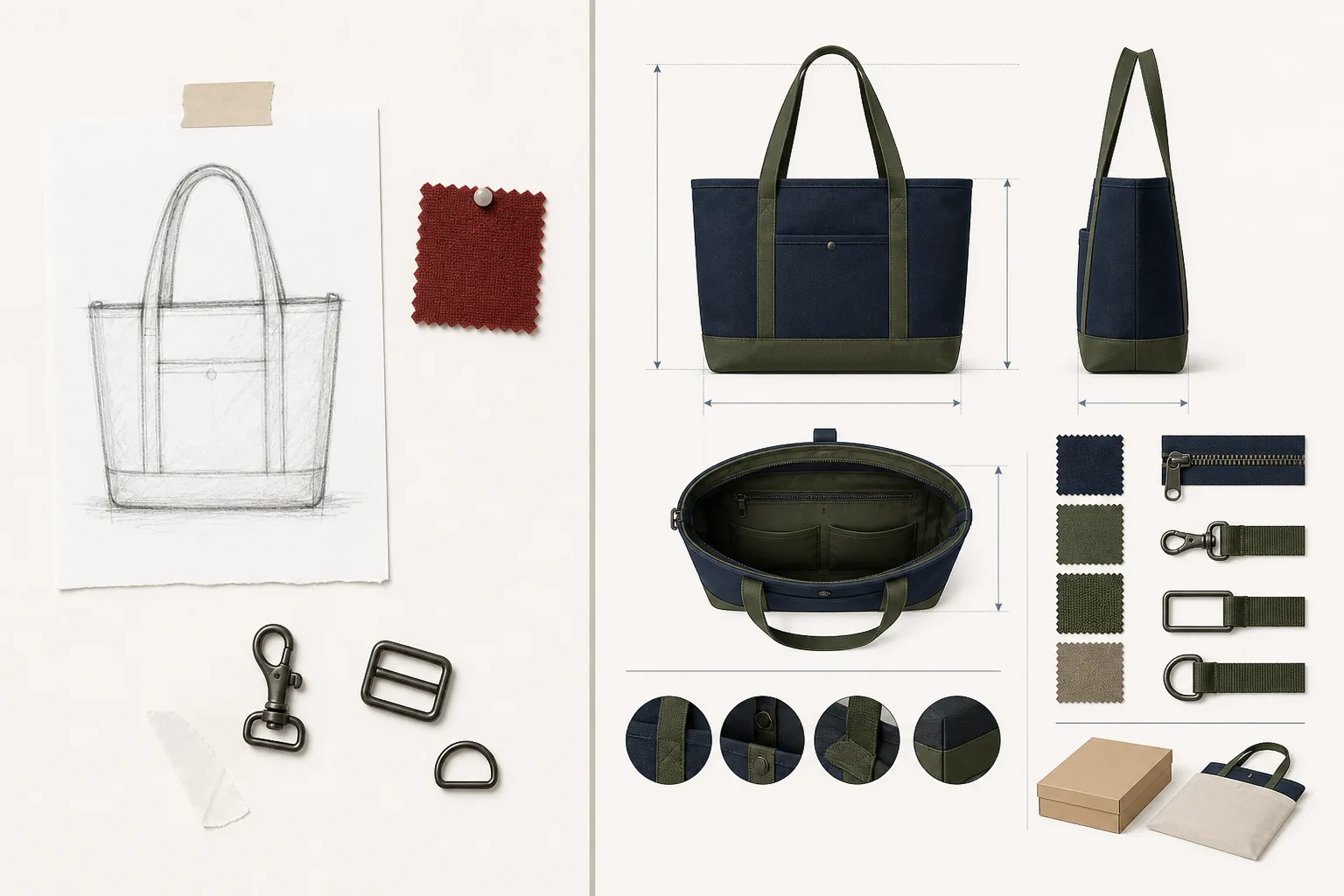
- Different pages show different pocket shapes, handle positions or closures.
- Dimensions conflict with the drawing, the use case or each other.
- The shell is specified while lining, padding or reinforcement is omitted.
- Artwork has no finished size, color, process or placement reference.
- Hardware is selected by appearance without dimensions or finish.
- Screen colors are treated as physical color approvals.
- Packaging, labeling or testing requirements appear only after sampling.
- Feedback changes the sample but never updates the master specification.
From Concept to Approved Production Reference
A typical development path moves from the initial brief through specification review, material selection, quotation and prototype development. The first prototype tests proportion, function and construction. Buyer feedback is then translated into measurable changes—not comments such as “make it more premium.”
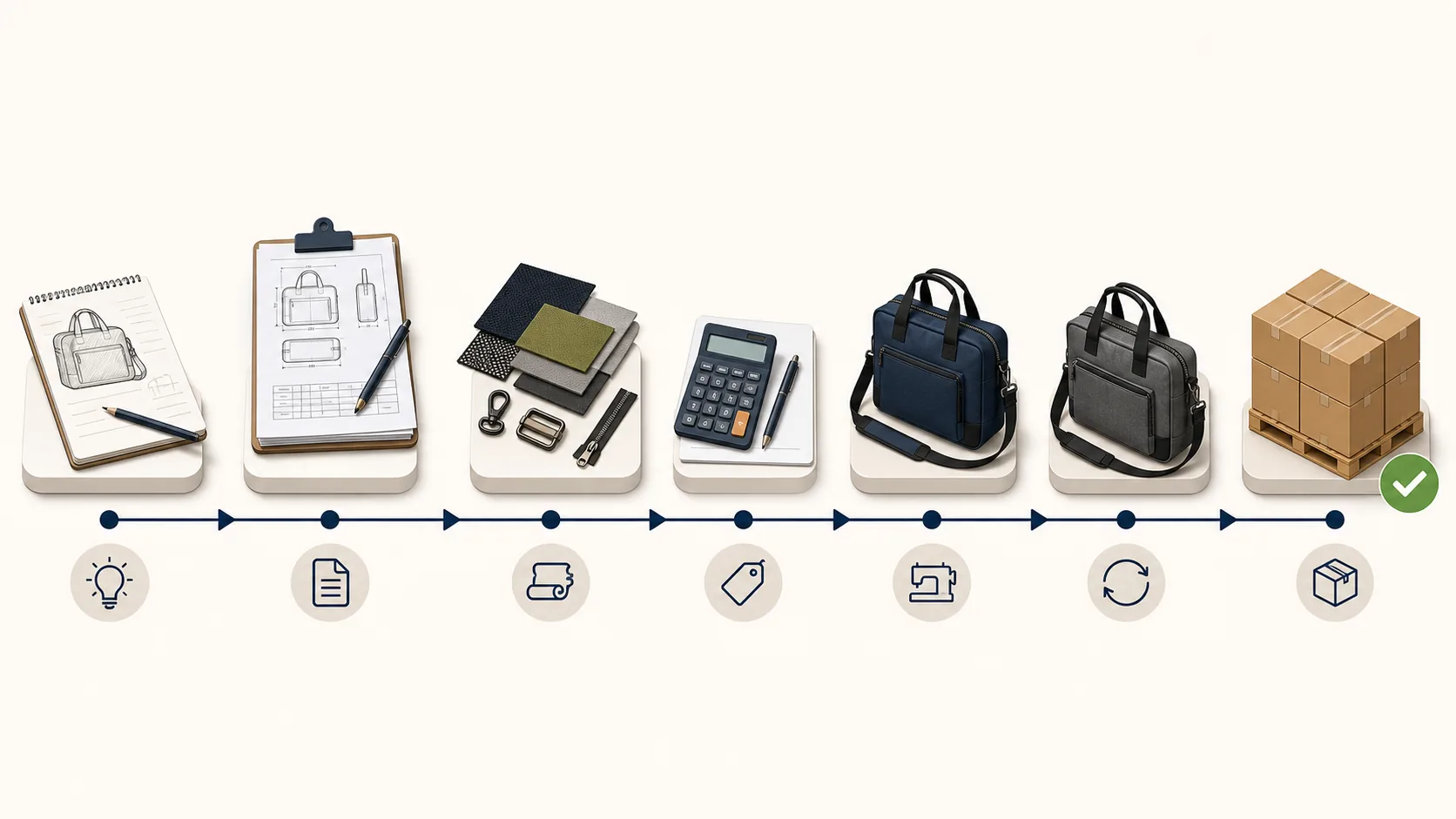
After revisions, the pre-production sample should represent the approved materials, colors, branding, construction and workmanship used as the bulk reference. Record any agreed exception. See the full custom bag development process for the surrounding workflow.
Sample Approval Is Not the End of Documentation
Approving a physical sample without updating the tech pack creates two competing references. If the sample has a wider strap or different zipper than the document, the factory may not know which one controls bulk production.
- Review the sample against the current revision, not from memory.
- Record every accepted and rejected deviation.
- Update drawings, measurements, BOM rows, artwork and packaging pages.
- Issue the next revision as one complete file.
- Identify the approved physical sample and date.
- Confirm that costing and lead time still match the revised specification.
Pre-Quotation and Sampling Checklist
- Product name and intended use
- Target user and market
- Estimated order quantity
- All exterior and interior views
- Finished dimensions
- Points of measure
- Shell and lining specifications
- Padding and reinforcement
- Hardware dimensions and finish
- Logo method and artwork
- Color approval references
- Construction callouts
- Packaging requirements
- Required testing
- Delivery destination
- Target timeline
This checklist helps a supplier identify cost drivers and open decisions, but it does not replace a project-specific specification review. Keep intentionally open items labeled and assign an owner and deadline for confirmation.
Frequently Asked Questions
What information does a bag manufacturer need for a quotation?
At minimum, share the bag type, approximate dimensions, target material, estimated order quantity, branding method, packaging needs, destination and reference images. More precise specifications support a more reliable quotation.
Can a manufacturer quote from a sketch or reference photo?
An early estimate may be possible, but a sketch or photo usually leaves materials, construction and dimensions open to interpretation. Confirm those details before treating the quotation as final.
Do I need a tech pack before ordering a sample?
A complete document is not always required to begin a discussion, but the sample brief should define enough detail for both parties to judge whether the prototype matches the intended product.
Which file format should I use for a bag tech pack?
A clearly organized PDF is convenient for review. Supply editable vector files such as AI, EPS or SVG separately for logos and artwork, and keep a dated master version under revision control.
Should Pantone colors be included in a tech pack?
Pantone references can reduce ambiguity, but color should still be confirmed against the selected material because texture, coating, dye method and lighting affect appearance.
What is the difference between a prototype and a pre-production sample?
A prototype tests the design and construction. A pre-production sample should reflect the approved materials, colors, branding and workmanship that will guide bulk production.
Have a Bag Concept Ready for Review?
Share the product type, dimensions, quantity, materials, artwork and target timeline. MerrisBags will identify open decisions before sampling and prepare a project-specific manufacturing quotation.
Request a Quote Contact MerrisBags