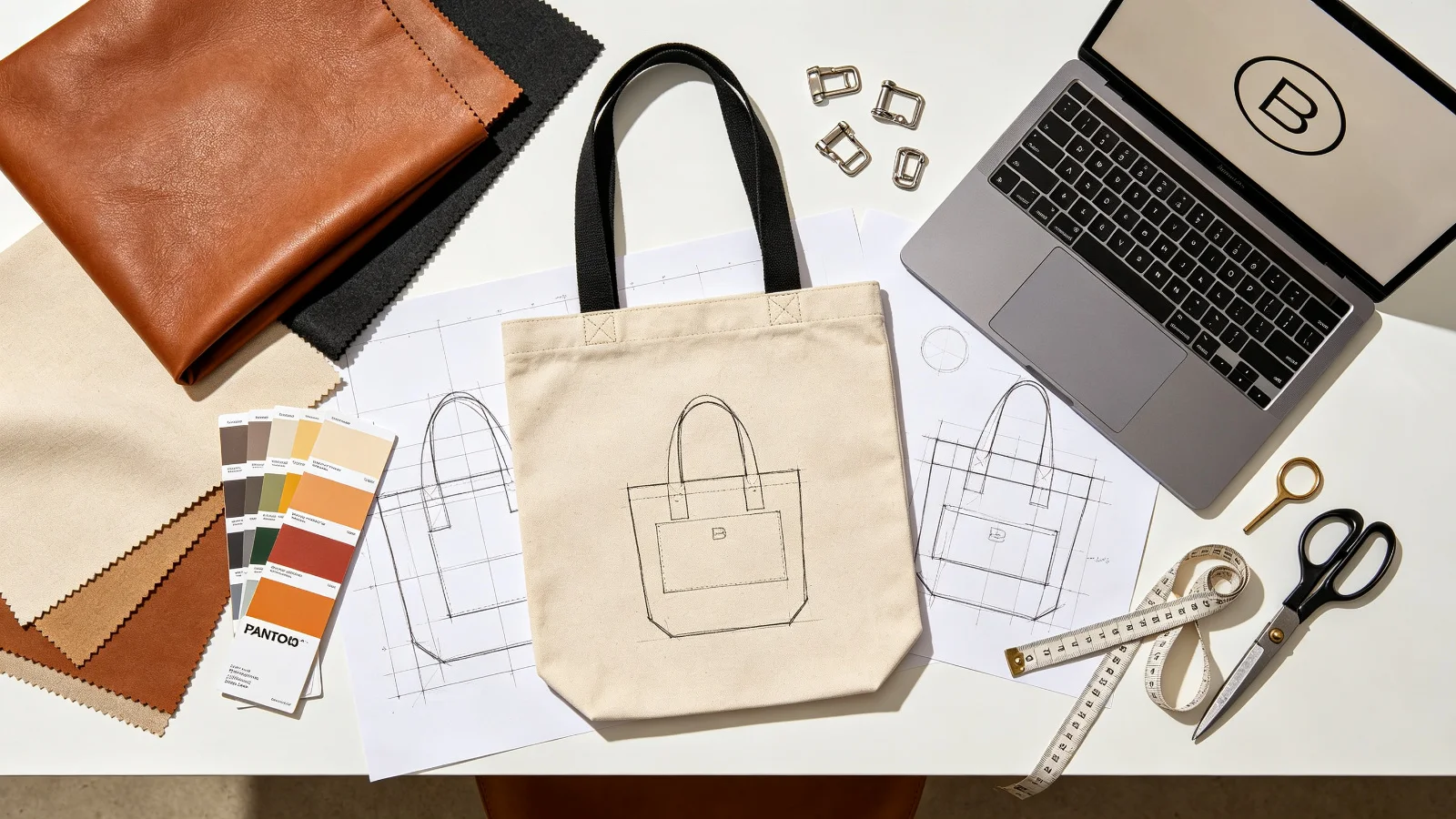
Every week we get emails from people who want to start a bag brand. They've got a logo, a mood board, and a rough idea of the bag they want to make. What they don't have is a realistic sense of what comes next — and that's where 80% of first-time launches stall or fail.
This guide isn't theoretical. It's built on the actual production timelines, cost structures, and failure patterns we see across hundreds of brand launches. We'll walk through every phase with real numbers, and we'll tell you exactly where people waste money and time.
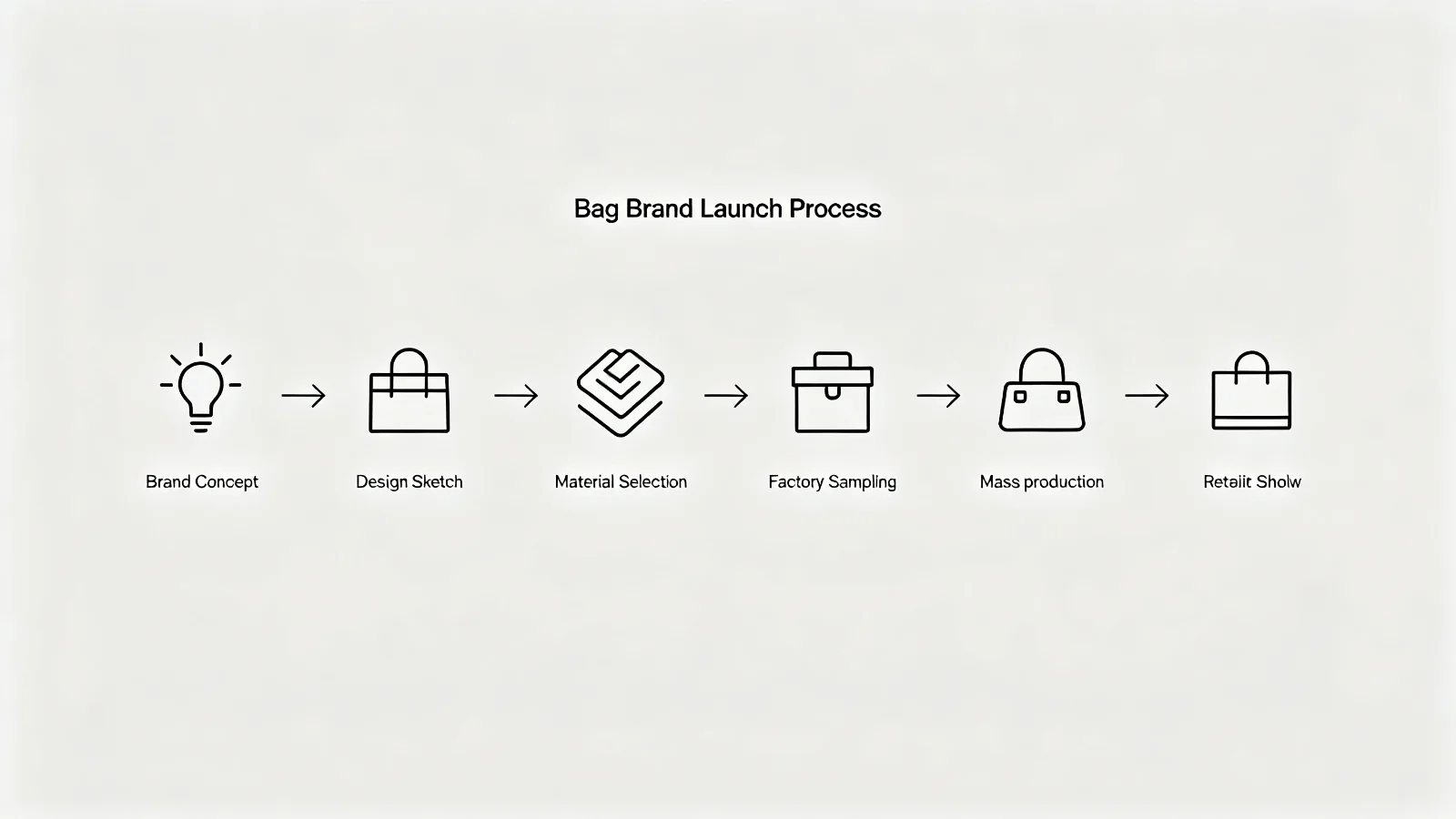
Phase 1: Brand Positioning & Market Validation (3-6 weeks)
Brand Positioning & Market Validation
3-6 weeks | $500-$3,000
Before you touch a fabric swatch or email a factory, you need to answer three questions that will determine everything else:
- Who is this for? "Women who like bags" is not an answer. "Urban professional women aged 28-40 who commute by public transit and need a bag that fits a 14-inch laptop, water bottle, and makeup pouch under $150" is.
- What's the price point? This dictates every material choice. A $39 retail tote uses 600D polyester and nylon zippers. A $189 tote uses full-grain leather and YKK Excella. Don't design first and price later — it never works.
- What's your differentiation? If you're selling a black leather tote at $150, you're competing with 500 brands doing the exact same thing. Your differentiation could be a patented closure, a specific sustainability claim, a niche use case (diaper bags that don't look like diaper bags), or a strong brand story around the artisan community.
Market validation doesn't require a focus group or a $10,000 research report. It requires you to look at what's actually selling. Search Etsy, Amazon, and Instagram for bags in your target price range. Read the reviews — the 1-star reviews tell you what's missing in the market, the 5-star reviews tell you what people actually care about.
Phase 2: Design & Tech Pack Development (2-4 weeks)
Design & Tech Pack Development
2-4 weeks | $0-$1,500 (DIY) / $1,500-$5,000 (freelance designer)
A tech pack is the instruction manual for your bag. It tells the factory exactly what to make — dimensions, materials, hardware, stitching, lining, packaging, logo placement, and quality acceptance standards. Without a proper tech pack, you'll get quoted 5 different prices for what you think is the same bag, and every sample will be wrong in a different way.
Your tech pack should include:
- Technical drawings (front, back, side, bottom views) with every dimension labeled in centimeters
- Material spec sheet — fabric type, weight (gsm/oz), color (Pantone number), supplier if specified
- Hardware list — zipper brand/type, buckle material/finish, D-rings, snaps, magnets
- Construction details — stitch type, seam allowance, edge finishing, interfacing requirements
- Logo/brand spec — placement, dimensions, application method (embroidery/print/deboss/metal label)
- Packaging spec — polybag, dust bag, hang tag, box dimensions
- Quality acceptance criteria — what counts as a defect, AQL level
You can create a basic tech pack yourself using Illustrator or even PowerPoint if you're detail-oriented. For complex constructions (structured handbags, backpacks with multiple compartments), hire a freelance bag designer on Upwork or Fiverr — expect to pay $300-$800 per style. We've written a complete tech pack guide with a free template you can download.
Phase 3: Factory Sourcing & Sampling (4-8 weeks)
Factory Sourcing & Sampling
4-8 weeks | $100-$500 per sample (usually 2-3 rounds)
This is where most launches either get stuck or get scammed. The right factory for your first order is not the biggest factory — it's the factory that specializes in your bag type and accepts your order quantity.
Where to find factories
- Alibaba / Global Sources — filter by "Gold Supplier" and "Verified." Look for factories with 5+ years in business, 90%+ response rate, and product categories that match your bag type.
- Trade shows — Canton Fair (Guangzhou, twice yearly), Premiere Vision (Paris), Texworld (NYC). You can touch samples, meet factory reps in person, and compare 20+ suppliers in 2 days.
- Sourcing agents — a good agent charges 5-10% of order value but handles factory vetting, communication, quality inspection, and problem-solving. For a first order under $20,000, an agent often pays for itself by preventing one costly mistake.
- Referrals — ask other brand founders in your network. A warm introduction to a factory that already produces similar bags for a brand you admire is worth more than 50 Alibaba inquiries.
How to vet a factory before paying anything
Our manufacturer audit guide covers 18 verification points, but the non-negotiables for a first order are:
- They produce your bag category (don't ask a backpack factory to make a structured leather handbag — they'll outsource it and mark it up)
- They accept your MOQ (if they say "minimum 2,000 pieces" and you want 500, move on — they'll either refuse or charge you a premium that makes the unit cost uncompetitive)
- They agree to a paid sample before any deposit (a factory that refuses paid sampling is either a scam or doesn't actually make the product)
- They can provide references from brands in your country — and you actually call those references
The sampling process
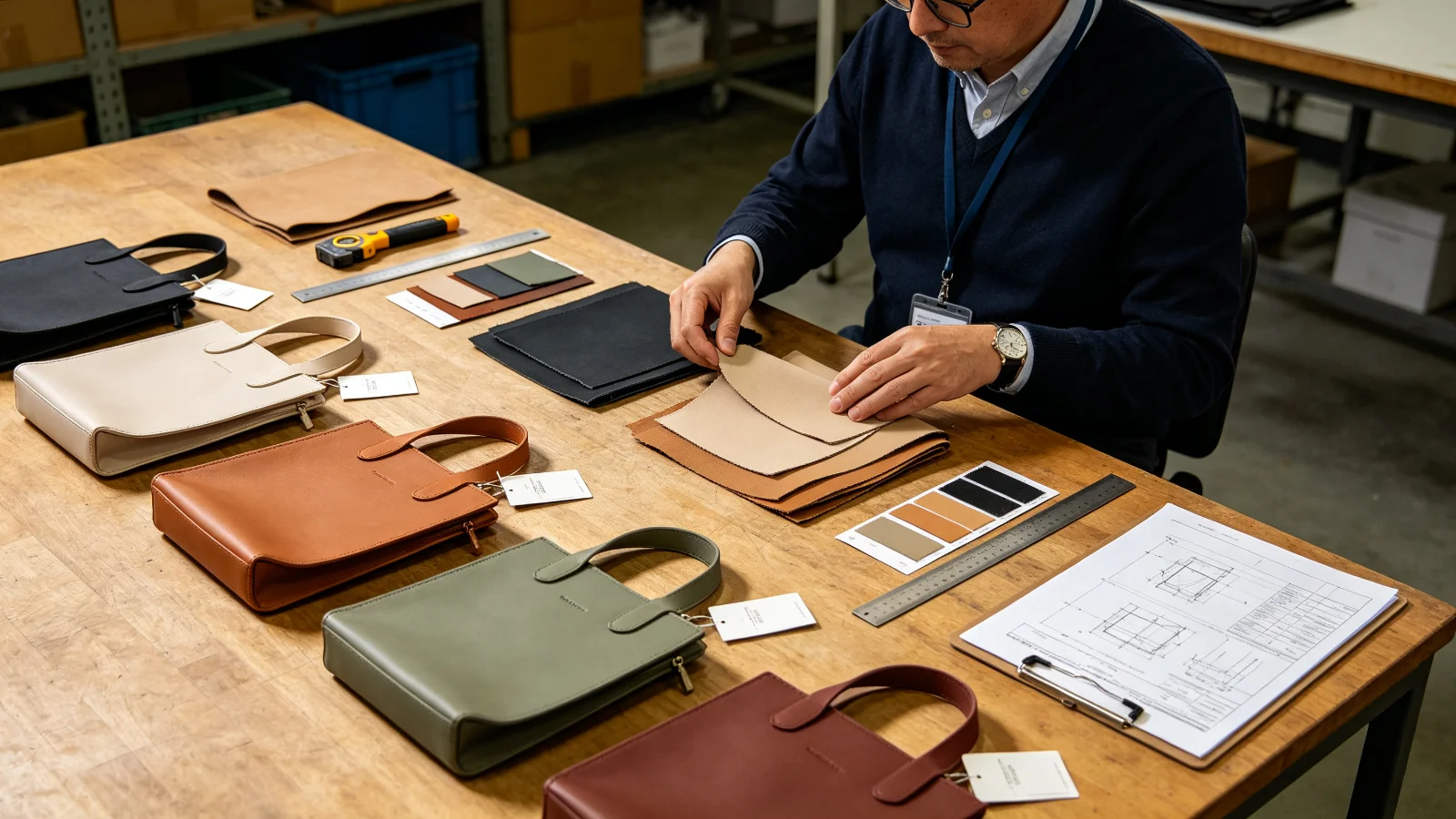
Send your tech pack to 3-5 factories simultaneously. Ask for a quotation and a sample. Sample fees typically range from $50 to $300 per style, and most factories will refund the sample fee if you place a bulk order. Expect each sample round to take 10-15 days of production plus 3-5 days of shipping (DHL/FedEx).
You will almost certainly need 2-3 rounds. Round 1: the factory interprets your tech pack and makes their best version. Round 2: you correct the issues (wrong dimensions, wrong hardware, poor stitching). Round 3: final tweaks and approval. Budget for this — it's not a sign that the factory is bad, it's the normal development process.
Phase 4: Pricing & Cost Validation (1-2 weeks, runs parallel to sampling)
Pricing & Cost Validation
1-2 weeks (parallel to sampling) | Build financial model
While you're waiting for samples, build your financial model. The number that matters is not the FOB price (what the factory charges you) — it's the landed cost (what it costs you to get the bag into your warehouse, ready to ship to a customer).
| Cost Component | % of FOB | Example (FOB $5.00) |
|---|---|---|
| FOB (factory price) | 100% | $5.00 |
| Ocean freight + insurance | 5-8% | $0.30 |
| US customs duty (bags: 17.6% on FOB) | 17.6% | $0.88 |
| Customs broker + port fees | 2-4% | $0.15 |
| Inland transport (port to warehouse) | 2-3% | $0.12 |
| Landed Cost | ~130% | ~$6.45 |
Once you know your landed cost, work backward from your target retail price to check margin:
- DTC (your own website): Retail price = landed cost × 4 to 6. A $6.45 landed cost retails at $26-$39. Gross margin: 75-84%.
- Wholesale (selling to boutiques/department stores): Wholesale price = landed cost × 2 to 2.5. Retailer then marks up 2-2.5x. A $6.45 landed cost wholesales at $13-$16, retails at $28-$40. Your gross margin: 50-60%.
- Marketplaces (Amazon/Etsy): Factor in 15% referral fee + FBA fees (~$5-7 per bag) + advertising (15-25% of revenue). Your net margin is usually 10-20% lower than DTC.
We've written a complete cost guide with per-style pricing across 11 bag types and 4 quantity tiers, plus a full 1,000-piece tote landed-cost breakdown.
Phase 5: Mass Production & Quality Control (25-45 days)
Mass Production & Quality Control
25-45 days production + 5-7 days inspection | 30% deposit upfront, 70% before shipment
Once you approve the final sample, you place a Purchase Order (PO) and pay the 30% deposit. The factory orders materials, cuts fabric, and schedules production line time. Standard production is 25-35 days for simple styles (totes, pouches) and 35-45 days for complex styles (backpacks, structured handbags).
Quality control — don't skip this
Your approved sample is the quality benchmark. But production runs of 500+ pieces will have variation. The industry standard is AQL 2.5 — meaning for a 500-piece order, 50 pieces are inspected and up to 5 major defects are acceptable. For a first order, we recommend AQL 1.0 (tighter) or a 100% inspection.
You have three QC options:
- Factory self-inspection (free) — the factory checks their own work. This is the least reliable option. We never recommend this for a first order.
- Third-party inspection ($150-$300 per inspection) — SGS, Intertek, Bureau Veritas, or a local inspection company sends an inspector to the factory. They check against your approved sample and tech pack. You get a detailed report with photos within 24 hours.
- You or your agent inspect in person (cost of travel) — the gold standard for a first order. You can feel the materials, check stitching, test zippers, and catch issues that a checklist inspector might miss.
Phase 6: Logistics, Customs & Launch (25-40 days)
Logistics, Customs & Launch
25-35 days sea freight / 5-7 days air freight | 5-10% of order value (sea) / 15-30% (air)
Your goods pass inspection, you pay the balance, and the factory books shipping. For a first order, sea freight LCL (Less than Container Load) is the standard choice — it's cheap but slow. Air freight is 3-5x more expensive but gets your inventory in 5-7 days.
Customs and duties
Bags entering the US carry a duty rate of 17.6% on the FOB value (HTS code 4202). This is one of the highest duty rates for consumer goods — factor it into your landed cost from day one. The EU duty rate is 2.7-14% depending on material. A customs broker ($150-$300 per shipment) handles all the paperwork and ensures you don't get hit with unexpected storage fees at the port.
Launch timing
Don't wait until inventory arrives to start marketing. Begin building your email list and social media presence 4-6 weeks before your expected delivery date. Tease the product, share behind-the-scenes content from the factory, and open pre-orders if you're confident in the delivery date. When the inventory lands, you should already have customers waiting.
Startup Budget: Three Launch Tiers
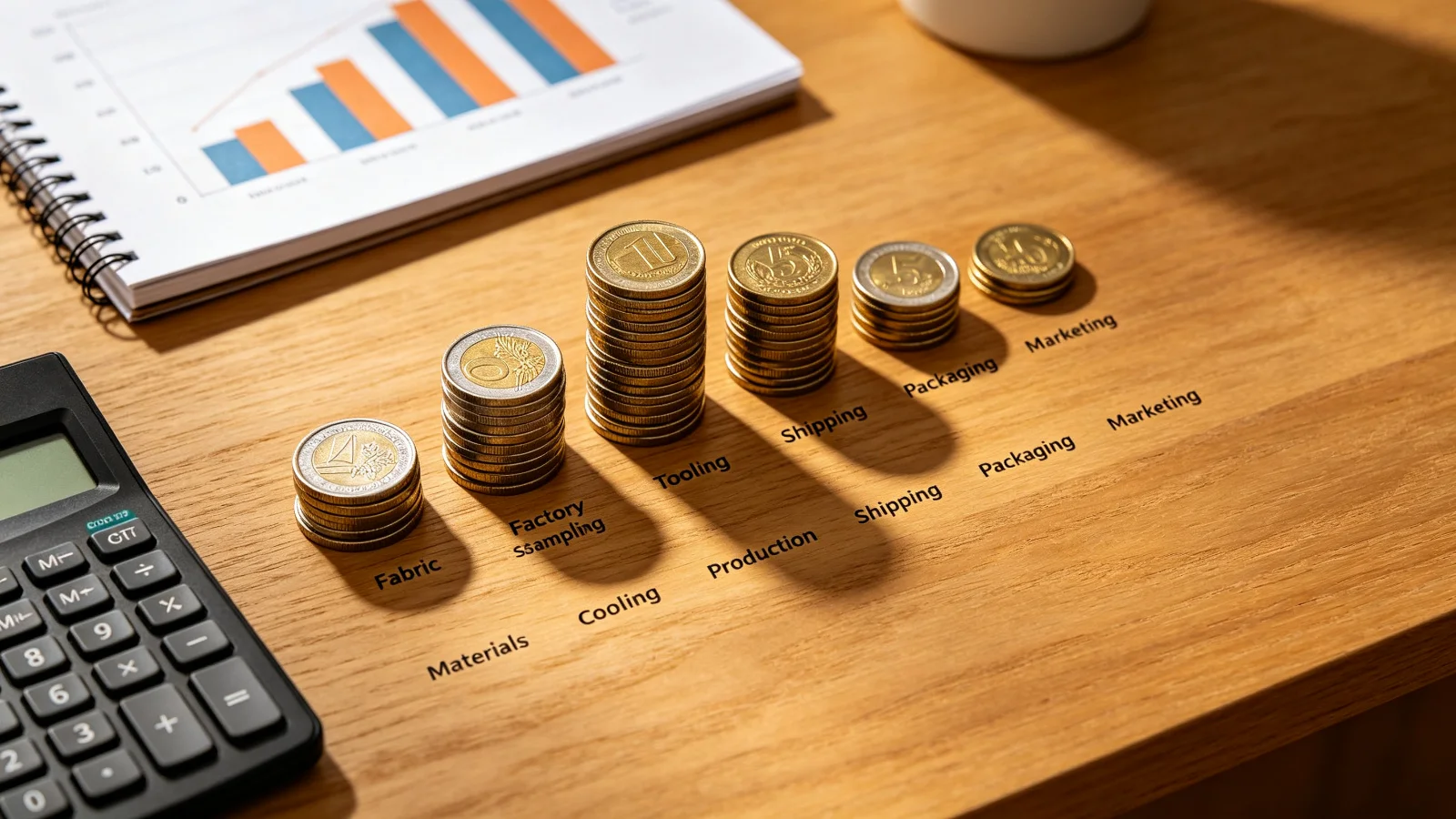
| Cost Category | Lean (1-2 styles) | Mid (3-5 styles) | Premium (5+ styles) |
|---|---|---|---|
| Brand & design (logo, tech packs) | $500-$1,500 | $1,500-$4,000 | $4,000-$10,000 |
| Sampling (2-3 rounds × 3-5 factories) | $300-$1,000 | $800-$2,500 | $2,000-$5,000 |
| Tooling & molds (custom hardware) | $0-$500 | $500-$2,000 | $2,000-$8,000 |
| Production (300-500 / 1,000+ / 3,000+ pcs) | $4,000-$10,000 | $15,000-$35,000 | $40,000-$100,000 |
| QC inspection | $150-$300 | $300-$800 | $800-$2,000 |
| Shipping & customs | $800-$2,000 | $2,500-$6,000 | $6,000-$15,000 |
| Packaging (dust bags, hang tags, boxes) | $300-$800 | $800-$2,000 | $2,000-$5,000 |
| Initial marketing & website | $1,000-$3,000 | $3,000-$8,000 | $8,000-$25,000 |
| Total | $7,050-$19,100 | $24,400-$60,300 | $64,800-$170,000 |
Timeline: From Zero to Shelf-Ready
| Phase | Duration | Cumulative |
|---|---|---|
| Brand positioning & competitive research | 2-3 weeks | 3 weeks |
| Design & tech pack development | 2-4 weeks | 7 weeks |
| Factory sourcing & initial inquiries | 1-2 weeks | 9 weeks |
| Sample round 1 | 2-3 weeks | 12 weeks |
| Sample round 2 (corrections) | 2-3 weeks | 15 weeks |
| Sample round 3 (final approval) | 2 weeks | 17 weeks |
| Mass production | 4-6 weeks | 23 weeks |
| QC inspection & rework (if needed) | 1 week | 24 weeks |
| Sea freight & customs | 4-5 weeks | 29 weeks |
| Total (typical) | — | 6-7 months |
If you use private label (factory's existing construction) instead of fully custom, you can cut the sampling phase to 2-3 weeks total and launch in 4-5 months. If you air freight instead of sea freight, you save 3 weeks but add 15-25% to your product cost.
The 7 Mistakes That Sink First-Time Bag Brands
- Ordering too much of an unproven style. Your first order should be the minimum you can sell in 3-4 months, not the quantity that gives you the best per-unit price. Unsold inventory is the #1 reason bag brands run out of cash.
- Skipping the tech pack. "Here's a photo, make it like this" wastes 2-3 sample rounds and produces a bag that doesn't match your vision. Every week of delayed sampling is a week of delayed revenue.
- Choosing the cheapest factory. The factory that quotes 20% less usually cuts corners on material quality, stitching, or hardware. A $0.50 per-unit savings on 500 pieces is $250 — but a 15% defect rate means 75 unsellable bags worth $1,500+.
- Forgetting duties and landed costs. US duty on bags is 17.6% — that's not a minor detail, it's a major cost component. Brands that price based on FOB instead of landed cost discover they're losing money on every sale after the first shipment arrives.
- Paying 100% upfront. Standard terms are 30/70. A factory demanding full payment before production is either a scam or has cash flow problems — both are bad signs.
- Skipping third-party QC. The factory's self-inspection report will always say "passed." Spend $200 on a third-party inspector — it's the cheapest insurance you can buy for a $10,000+ order.
- Trying to launch 5+ styles at once. Each additional style adds 2-4 weeks of sampling and $2,000-$5,000 in development cost. Launch with 1-2 hero styles, prove they sell, then expand.
Your First 90 Days: A Concrete Action Plan
If you're starting from zero today, here's exactly what to do:
Weeks 1-2: Research & Position
Define your target customer, price point, and differentiation in one paragraph. Research 10 competitors. Read their reviews. Identify the gap your bag fills. Decide: private label or fully custom? (If this is your first brand, start with private label.)
Weeks 3-5: Design & Tech Pack
Sketch your bag. Create a tech pack (DIY or hire a designer). Source fabric and hardware references. Decide on logo application method. Finalize packaging requirements.
Weeks 6-12: Source & Sample
Contact 5-8 factories. Narrow to 3. Order paid samples from all 3. Compare quality, communication, and pricing. Do 1-2 correction rounds with your top choice. Approve final sample.
Weeks 13-18: Produce & Inspect
Place PO, pay 30% deposit. Monitor production (ask for weekly photos). Schedule third-party inspection at 90% completion. Pay 70% balance after inspection passes.
Weeks 19-24: Ship & Launch
Book sea freight. Hire customs broker. While waiting, build email list and social media. Open pre-orders. Receive inventory. Fulfill pre-orders. Launch to the public.
Frequently Asked Questions
How much money do I need to start a bag brand?
A lean launch with 1-2 styles and 300-500 pieces per style typically requires $8,000-$15,000 in product costs (sampling, tooling, production, shipping) plus $2,000-$5,000 for branding, packaging, and initial marketing. A mid-tier launch with 3-5 styles and 1,000+ pieces runs $25,000-$60,000. These are product-side costs only — exclude your operating expenses, website, and inventory holding costs.
How long does it take to launch a bag brand from scratch?
Realistically 4-7 months for a first collection. Brand positioning and design: 3-6 weeks. Tech pack development: 2-4 weeks. Factory sourcing and sampling: 4-8 weeks (2-3 sample rounds). Production: 25-45 days. Sea freight and customs: 25-35 days. If you air freight, you can cut 3 weeks but pay 3-5x more per kg. First-time founders almost always underestimate the sampling iteration time.
Should I use private label, white label, or fully custom manufacturing?
White label (rebranding existing stock designs) is fastest and cheapest but offers zero differentiation — you compete on price alone. Private label (factory's existing mold/construction with your fabric, color, and logo) is a good middle ground: 4-6 week lead time, lower MOQ, some differentiation. Fully custom (your own design from scratch) takes 3-6 months of development but builds real brand equity. Most successful brands start with private label for 1-2 hero styles, then introduce fully custom pieces in season 2.
What MOQ should I expect for a first bag order?
For fully custom bags, most Chinese factories require 500-1,000 pieces per style and colorway. Private label orders can start at 300 pieces per style. Smaller factories or trading companies may accept 100-200 pieces but charge 20-40% more per unit. The MOQ is driven by fabric minimums (usually 300-500 yards per dye lot), hardware minimums, and production line setup costs. Read our detailed MOQ guide for the full breakdown.
How do I find a reliable bag manufacturer without getting scammed?
Start with verified platforms (Alibaba Gold Suppliers, Global Sources), trade shows (Canton Fair, Premiere Vision), or industry referrals. Always request a paid sample before any deposit — a factory that refuses paid sampling is a red flag. Verify business licenses, ask for client references, and consider a third-party inspection (SGS, Intertek, or a local sourcing agent) for your first order. Never pay 100% upfront; standard terms are 30% deposit / 70% before shipment. Our manufacturer audit checklist walks through 18 verification points.
What is the typical profit margin for a bag brand?
Direct-to-consumer bag brands typically target 55-65% gross margin (retail price minus landed cost). Wholesale accounts run 40-50% margin. For example, a tote with a $4.50 landed cost might retail at $39.99 (89% gross margin) or wholesale at $18 (75% margin). But gross margin isn't profit — you still need to cover marketing (often 20-30% of revenue), returns, platform fees, shipping subsidies, and overhead. A healthy DTC bag brand nets 10-20% after all costs.
Ready to Move From Sketch to Production?
Send us your tech pack or even a rough sketch — we'll review it for free, tell you if it's production-ready, and give you a transparent quotation within 48 hours. No minimums on sampling, no hidden fees.
Get a Free Quote & Sample Explore Material Options