Introduction
When a beauty brand buyer asks "how much does a custom cosmetic bag cost?" the answer is almost never a single number. It is a stack of decisions — fabric weight, lining type, zipper grade, logo method, interior compartments, packaging — each one shifting the unit price by 5% to 30%. Most factories quote a lump sum and hide the breakdown, leaving buyers guessing whether they are overpaying for fabric or subsidizing unnecessary craftsmanship.
This article tears open a real 1,000-piece OEM cosmetic bag project that ran through our Dongguan production line in Q2 2026. We share the exact specifications, line-by-line cost components, sampling fees, bulk pricing range, the specific changes that would have lowered the per-unit cost, and the full production timeline. For broader context on custom bag manufacturing pricing across all bag categories, see our complete 2026 custom bag manufacturing cost guide.
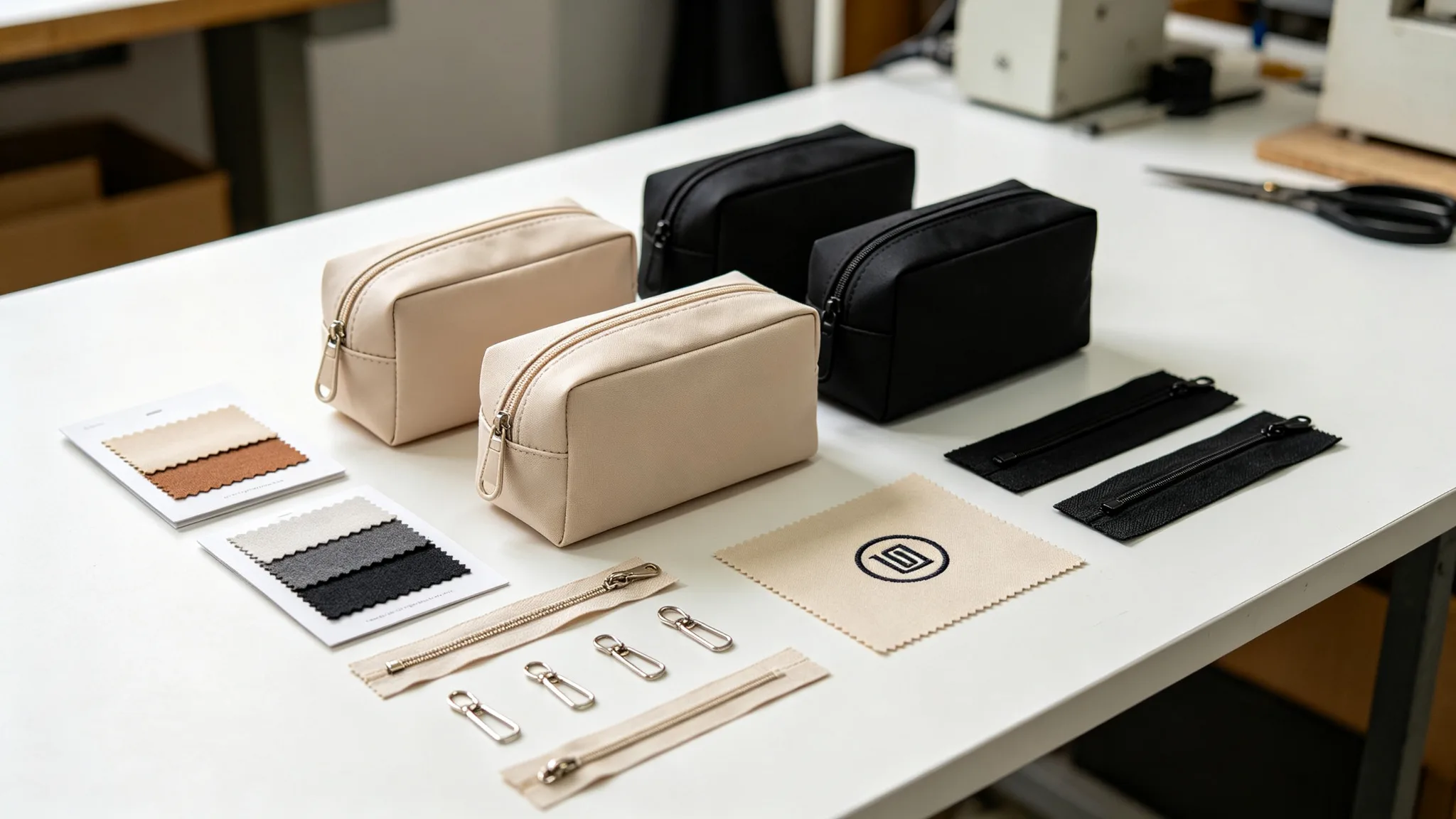
Project Specifications: Quantity & Dimensions
The buyer was a US-based indie beauty brand launching a holiday gift-with-purchase (GWP) program. They needed a compact pouch that could hold a lipstick, mini mascara, two eyeshadow singles, and a compact mirror — small enough to slip into a tote, structured enough to stand on a vanity.
Core Order Specs
| Parameter | Specification |
|---|---|
| Order Quantity | 1,000 pieces (single style, single color) |
| Dimensions (W × H × D) | 20 cm × 15 cm × 8 cm (7.9" × 5.9" × 3.1") |
| Shape | Rectangular stand-up pouch with boxed bottom |
| Closure | Top zipper across full width |
| Interior | One main compartment + one open slip pocket |
| Exterior Features | Embroidered logo on front center, woven side label |
| Color | Custom-dyed dusty rose (Pantone 16-1715 TPX) |
| Packaging | Individual polybag + barcode sticker, 50 pcs per export carton |
The 1,000-piece quantity sits right at the threshold where factories transition from "small batch" pricing to standard bulk pricing. Below 500 pieces, per-unit labor and setup costs spike significantly; above 2,000 pieces, fabric purchasing power and production line efficiency drive the unit cost down further. For brands testing a new style, our MOQ guide for custom bags explains how to negotiate lower first-order quantities without paying a massive premium.
Material Cost Breakdown
Every cosmetic bag is a sandwich of materials. The exterior fabric determines durability and perceived quality; the lining protects contents and provides a premium unboxing feel; the zipper is the single most-used component and the most common point of failure; the logo craft is where brand identity meets production cost. Here is how each component priced out at 1,000 pieces.
Exterior Fabric: 420D Nylon with PU Coating
The buyer selected 420D nylon with a lightweight PU backing — the workhorse fabric for mid-tier cosmetic pouches. It offers water resistance, clean stitching, and a smooth matte finish that takes embroidery well. At 1,000 pieces, fabric consumption was approximately 0.18 square meters per unit (including cutting waste), and the custom-dyed dusty rose color added a small dye-lot surcharge.
- Fabric cost per unit: $0.42 – $0.55
- Share of total unit cost: 22–28%
- Why this range: Custom dyeing adds $0.05–$0.08/unit vs. in-stock colors; fabric prices fluctuate with nylon monomer markets.
Lining: 210D Polyester
A 210D polyester lining in matching dusty rose was used. This is the standard lining weight for cosmetic bags — smooth enough to prevent snags on makeup packaging, durable enough for daily use, and economical. The lining was cut with a single interior slip pocket (10 cm × 8 cm), adding a small amount of extra fabric and stitching time.
- Lining cost per unit: $0.12 – $0.18
- Share of total unit cost: 6–9%
- Upgrade path: Satin lining (+$0.15–$0.25/unit) for luxury positioning; waterproof TPU lining (+$0.20–$0.35/unit) for leak-prone liquid products.
Zipper: #5 Nylon Coil with Custom Pull
A #5 nylon coil zipper (22 cm length, slightly longer than the bag opening for clean end stops) was specified. The buyer opted for a custom-molded zipper pull with their logo debossed — a small detail that significantly elevates perceived quality. Standard #5 nylon zippers are inexpensive, but the custom pull added a tooling fee amortized across the 1,000 units.
- Zipper + pull cost per unit: $0.22 – $0.32
- Share of total unit cost: 11–15%
- YKK upgrade: YKK #5 nylon zipper adds $0.15–$0.25/unit but is the gold standard for smooth operation and durability. For reference, our multi-compartment oxford cosmetic bag uses YKK zippers as standard.
Logo Craft: Front Embroidery + Woven Side Label
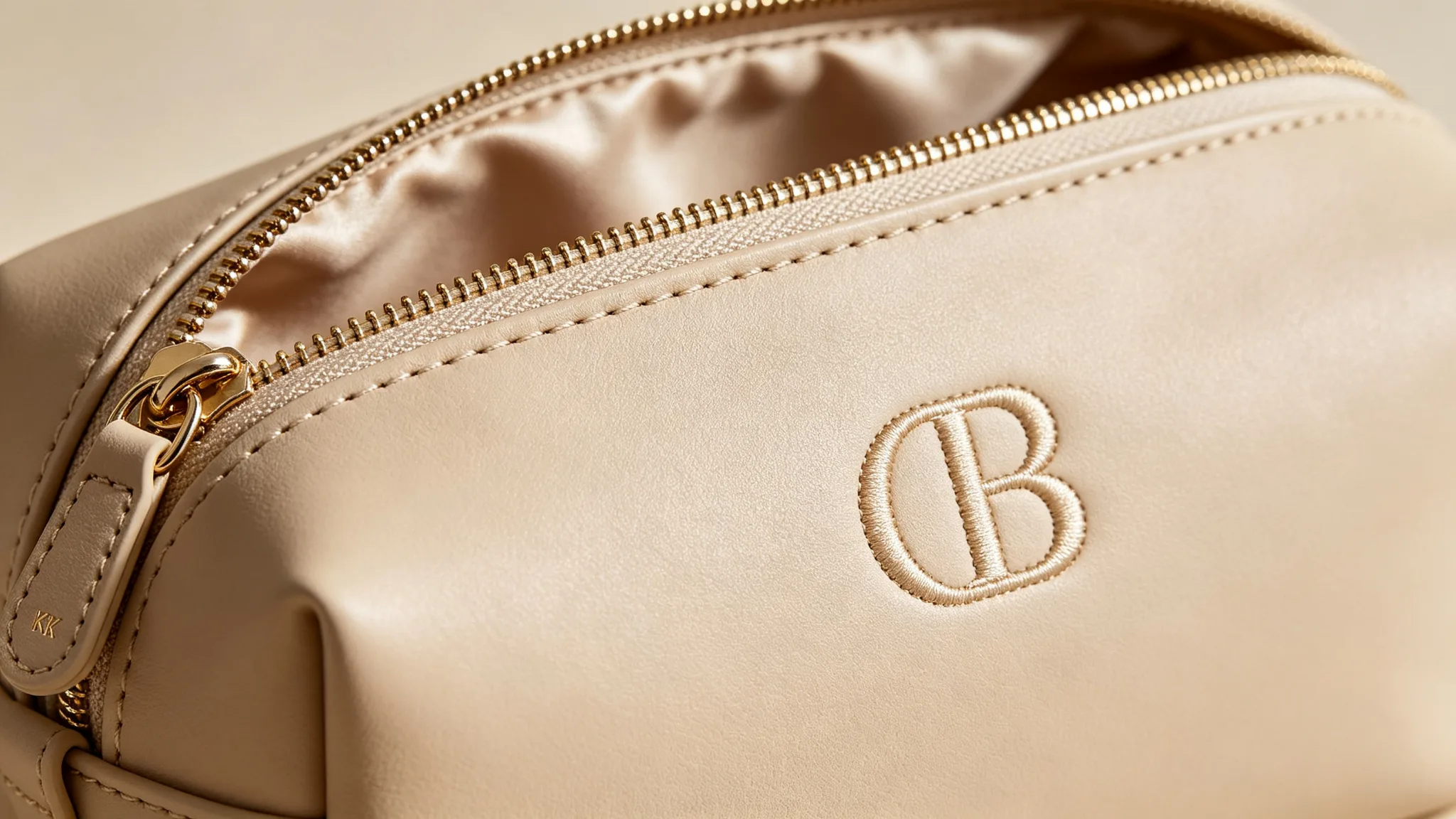
The brand logo (approximately 5 cm × 3 cm, 4 colors) was embroidered on the front center panel. Embroidery was chosen over printing because it delivers a tactile, premium feel that aligns with a beauty GWP program — recipients can feel the stitching, and it will not crack or peel over time. A small woven side label (1.5 cm × 3 cm) was added at the side seam for subtle brand reinforcement.
- Embroidery cost per unit: $0.18 – $0.28
- Woven label cost per unit: $0.06 – $0.10
- Combined logo cost per unit: $0.24 – $0.38
- Share of total unit cost: 12–17%
- Cheaper alternatives: Screen print ($0.08–$0.15/unit) or heat transfer ($0.06–$0.12/unit) would cut logo cost by 50–60%. Our logo craft selection guide compares all 8 common branding methods.
Sampling Fee & Bulk Pricing
Now we arrive at the numbers buyers actually care about: what did this project cost to develop, and what was the per-unit price for 1,000 pieces?
Sample Development Fee
The sampling process included: pattern making based on the buyer's tech pack, material sourcing (custom dyeing the dusty rose fabric), one round of embroidery digitization, and construction of a physical prototype. The buyer requested two small revisions (adjusting pocket depth and tightening zipper end stops), which were included in the original sample fee.
- Sample fee: $100 USD (one style, up to 2 revision rounds)
- Sample turnaround: 8 business days (including international courier to the US)
- Refund policy: Fully refunded against the bulk order of 1,000 pieces — the buyer received a $100 credit on their final invoice.
- Additional sample copies: $25 each if the buyer needed more than one physical sample for internal review.
Bulk Unit Price Breakdown (1,000 Pieces)
Here is the full line-by-line FOB (Free On Board) unit cost. FOB means the price includes everything up to the goods being loaded onto the ship at the port of departure (Shenzhen/Yantian). International freight, insurance, import duties, and destination handling are separate.
| Cost Component | Low (USD/unit) | High (USD/unit) | % of Total |
|---|---|---|---|
| Exterior fabric (420D nylon, custom dye) | $0.42 | $0.55 | 22–28% |
| Lining (210D polyester + slip pocket) | $0.12 | $0.18 | 6–9% |
| Zipper (#5 nylon + custom pull, amortized tooling) | $0.22 | $0.32 | 11–15% |
| Logo (embroidery + woven side label) | $0.24 | $0.38 | 12–17% |
| Thread, interfacing, labels, small trims | $0.08 | $0.12 | 4–6% |
| Labor (cutting, sewing, finishing, QC) | $0.48 | $0.65 | 28–34% |
| Factory overhead (energy, equipment, management) | $0.12 | $0.18 | 6–9% |
| Packaging (polybag + barcode + export carton) | $0.08 | $0.12 | 4–6% |
| FOB Unit Price | $1.76 | $2.50 | 100% |
| Total Order Value (1,000 pcs) | $1,760 | $2,500 | — |
The actual quoted price for this project landed at $2.15 per unit FOB Shenzhen, for a total of $2,150 before the $100 sample refund (net $2,050). This sits in the middle of the range because the buyer chose custom-dyed fabric and a custom zipper pull — both premium choices — but kept the interior simple (one slip pocket, no brush holders, no waterproof lining).
Key takeaway: At 1,000 pieces, labor is the single largest cost component (28–34%), not fabric. This means design decisions that reduce sewing time — fewer compartments, simpler closures, standard shapes — have a bigger impact on price than downgrading fabric.
Cost Reduction Levers: What Would Have Lowered the Price
During the quotation phase, we presented the buyer with five specific changes that would reduce the unit cost. They ultimately kept their premium specs, but these are the levers any brand can pull to hit a tighter target price.
Lever 1: Increase Quantity to 2,000+ Pieces (Saves 12–18%)
Doubling the order quantity from 1,000 to 2,000 pieces would have reduced the FOB unit price to approximately $1.75–$1.95. The savings come from three sources: bulk fabric purchasing (lower per-meter price), amortized setup costs (pattern, embroidery digitization, zipper pull tooling spread over more units), and longer production runs (higher line efficiency, less changeover time). At 5,000 pieces, the unit price drops further to $1.50–$1.70.
Lever 2: Use In-Stock Fabric Instead of Custom Dyeing (Saves 5–8%)
Custom dyeing the dusty rose fabric added a $0.05–$0.08 surcharge per unit and extended material procurement by 3–5 days. Selecting from our in-stock color library (which includes 40+ standard colors across nylon, polyester, canvas, and PU) would have eliminated the dye-lot fee and reduced the unit price to $1.68–$2.40. For brands with flexible brand colors, this is the fastest way to cut cost without changing quality.
Lever 3: Switch from Embroidery to Screen Print or Heat Transfer (Saves 8–12%)
Embroidery at $0.18–$0.28/unit is the most expensive logo method for this bag size. Switching to screen print ($0.08–$0.15/unit) or heat transfer vinyl ($0.06–$0.12/unit) would reduce the combined logo cost from $0.24–$0.38 to $0.14–$0.25, saving approximately $0.10–$0.13 per unit. The tradeoff is durability and perceived quality — prints can crack or peel after repeated use, while embroidery lasts the lifetime of the bag. For a GWP program with a 3–6 month usage lifecycle, print is often the rational choice. Our Tyvek printed logo cosmetic bag demonstrates how print-based branding can still look premium.
Lever 4: Use Standard Zipper Pull Instead of Custom Molded (Saves 3–5%)
The custom-molded zipper pull required a $150 tooling fee amortized across 1,000 units ($0.15/unit) plus a higher per-unit pull cost ($0.08 vs. $0.03 for a standard pull). Switching to a standard nylon pull with a printed or woven logo tag would save approximately $0.08–$0.12 per unit. This is a subtle detail that most end users do not consciously notice, making it a low-impact place to trim budget.
Lever 5: Simplify Interior — Remove Slip Pocket, Use Single-Layer Lining (Saves 4–7%)
The interior slip pocket added extra fabric, cutting steps, and approximately 2 minutes of sewing time per unit. Removing it and using a single-compartment interior would save $0.08–$0.15 per unit. For a GWP pouch that holds only a few items, the slip pocket is often unnecessary. Similarly, using a lighter 190T lining instead of 210D would save $0.02–$0.04/unit with minimal functional difference for cosmetic use.
Combined Savings Scenario
If the buyer had applied all five levers (2,000 pcs, in-stock fabric, screen print, standard pull, no interior pocket), the FOB unit price would have dropped to approximately $1.30–$1.55 — a 30–40% reduction from the actual $2.15 quote. The art of sourcing is deciding which levers preserve brand value and which ones are invisible to the end customer.
Production Lead Time
A 1,000-piece cosmetic bag order is not a 3D-printed object — it requires material procurement, cutting, sewing, QC, and packaging, each with its own dependencies. Here is the actual timeline for this project, from inquiry to shipment.
Inquiry & Quotation
Buyer submits reference images and basic specs. MerrisBags responds within 24 hours with a preliminary price range and a list of material options. A detailed tech pack is developed collaboratively.
Sample Development
Pattern making, material sourcing (including custom dyeing), embroidery digitization, and prototype construction. Two revision rounds included. Sample shipped via DHL/FedEx for buyer review.
Sample Approval & Material Procurement
Buyer approves the pre-production sample. Bulk fabric is ordered (custom-dyed fabric requires 3–5 days), zippers and labels are pulled from inventory or ordered, and the production schedule is locked.
Cutting & Pre-Production Setup
Fabric is inspected, layered, and die-cut. Embroidery machines are set up with the approved digitized logo. A pre-production (PP) sample is sewn from the actual bulk materials and signed off by the QC team.
Bulk Production & In-Line QC
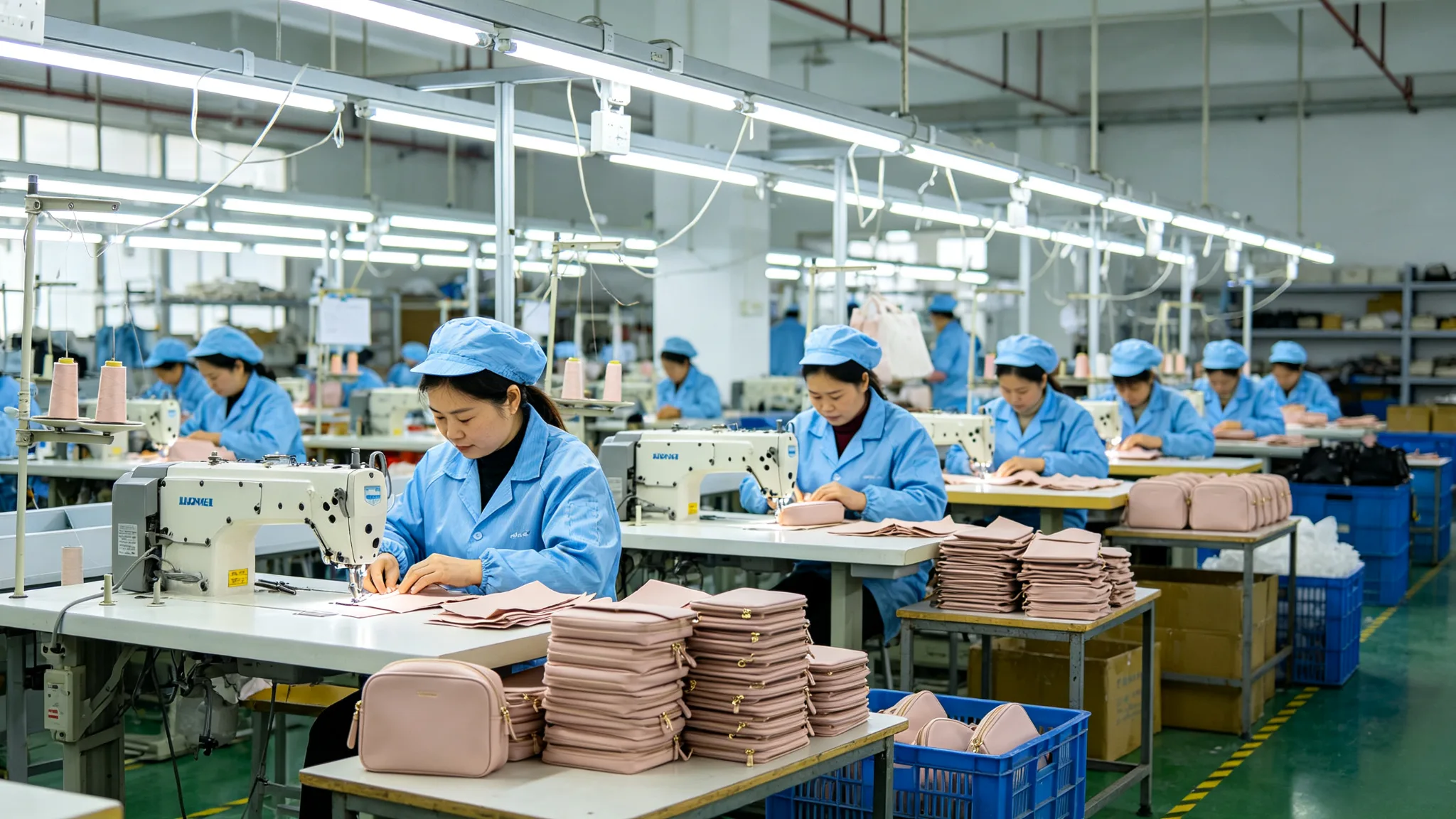
1,000 pieces move through the sewing line: exterior assembly, lining insertion, zipper installation, embroidery application, and finishing. In-line QC inspects 20% of units at each workstation. Weekly production photos are sent to the buyer.
Final Inspection & Packaging
AQL 2.5 final random inspection (125 units sampled). Passed units are individually polybagged with barcode stickers, packed 50 per export carton, and cartons are marked with PO number, dimensions, and weight.
Booking & Shipment
Freight forwarder books container space, goods are trucked to Shenzhen/Yantian port, and loaded onto the vessel. FOB terms are fulfilled. Sea freight to US West Coast takes 14–18 days; to US East Coast 25–30 days.
Total production cycle (inquiry to FOB shipment): 31–33 business days. Bulk production alone (after material arrival) took 13 business days. For time-critical launches, our rush production lane can compress bulk production to 10–12 days by assigning a dedicated production line and running overtime — this typically adds 10–15% to the unit price but can save 5–7 calendar days.
Frequently Asked Questions
What is the typical unit price for a 1,000-piece custom cosmetic bag order?
For a standard 20 × 15 × 8 cm cosmetic bag with 420D nylon exterior, 210D polyester lining, #5 nylon zipper, and embroidered logo, the FOB unit price typically ranges from $1.76 to $2.50 USD at 1,000 pieces. The total order value falls between $1,760 and $2,500 USD before freight and duties. Premium upgrades (YKK zippers, PU leather, satin lining, custom hardware) push the price to $3.00–$4.50/unit. For a broader view across all bag types, see our 2026 custom bag manufacturing cost guide.
How much does sampling cost for a custom cosmetic bag?
Sample development fees range from $80 to $150 USD per style, depending on complexity and logo craft. Most factories, including MerrisBags, refund the sampling fee when the bulk order reaches 1,000 pieces or more. Sample turnaround is 7 to 10 business days, including international courier. For brands that need a complete technical specification before sampling, our bag tech pack guide walks through every required specification.
Which cost components have the biggest impact on cosmetic bag pricing?
The three largest cost drivers are labor and manufacturing overhead (28–34% of unit cost), fabric (22–28%), and hardware including zippers (11–15%). Logo craft, lining, and packaging each account for 4–17%. Upgrading to YKK zippers or premium PU leather can increase the unit price by 20–40%. Because labor is the largest component, design simplification (fewer compartments, standard shapes, simpler closures) is often more cost-effective than material downgrading.
How can I reduce the unit cost of my custom cosmetic bag order?
The most effective cost reduction levers, ranked by impact: (1) increase order quantity to 2,000+ pieces (saves 12–18%), (2) switch from embroidery to screen print or heat transfer (saves 8–12%), (3) use in-stock fabric colors instead of custom dyeing (saves 5–8%), (4) simplify interior compartments and pockets (saves 4–7%), and (5) use standard zipper pulls instead of custom-molded (saves 3–5%). Combining all five can reduce the unit price by 30–40%.
What is the full production lead time for a 1,000-piece cosmetic bag order?
The complete cycle from inquiry to FOB shipment is approximately 31–33 business days: 1–2 days for quotation, 7–10 days for sampling, 2–3 days for sample approval and material procurement, 2 days for cutting and pre-production setup, 13 days for bulk production and QC, and 2–3 days for final packaging and booking. Rush production can compress bulk to 10–12 days with priority scheduling, typically adding 10–15% to the unit price.
Get Your Itemized Cosmetic Bag Quote
Every cosmetic bag project is a unique combination of fabric, hardware, logo, and structure — and the only way to get an accurate price is to break it down line by line, not accept a lump-sum quote that hides where your money is going. MerrisBags provides fully itemized FOB quotations for every project, listing fabric cost, labor, hardware, logo craft, packaging, and overhead separately, so you know exactly what you are paying for and where you can optimize.
Whether you are launching a 500-piece GWP test or scaling a 10,000-piece retail collection, our Dongguan factory can handle the full cycle from tech pack development to bulk production. Browse our complete cosmetic bag catalog for reference styles, or explore our low-MOQ custom quilted cosmetic bag program if you are testing a new style with a smaller first order.
To start your itemized quote, submit your brief through our website contact form or message us on WhatsApp at +86 151 1275 7120. You will receive a free rendering and a line-by-line cost breakdown within 24 hours.
The difference between a good cosmetic bag supplier and a great one is not the lowest quote — it is the willingness to show you exactly what is in that quote, and to help you optimize it without sacrificing the quality your brand stands for.