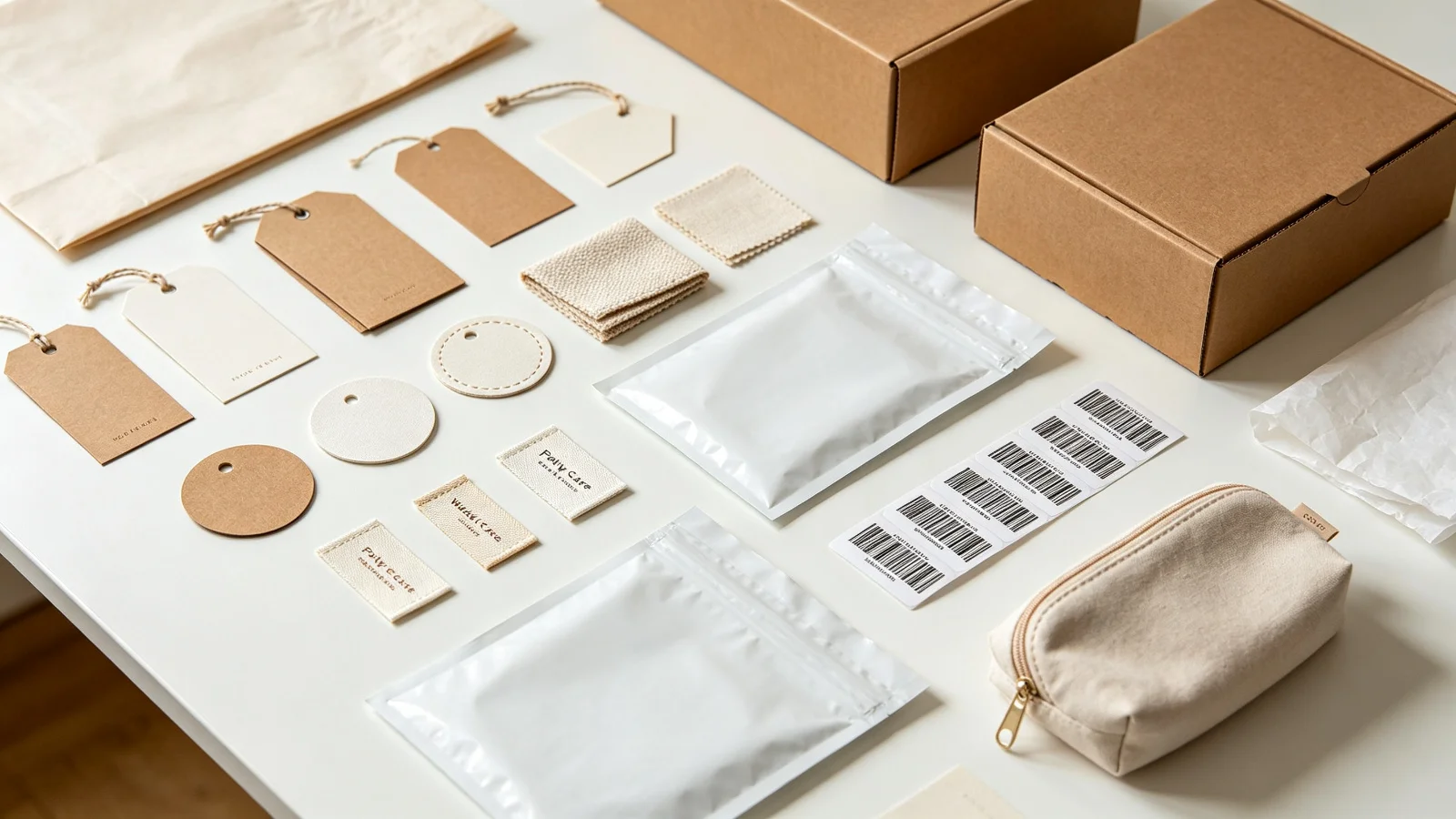
Packaging and labeling is the part of bag manufacturing that most buyers think about last — and regret first. A missing country of origin label can get your entire shipment detained at US Customs. A wrong barcode can get your Amazon listing suppressed. A care label without fiber content can trigger a €10,000+ fine in the EU. None of these are hard to get right, but they're all easy to get wrong if you don't know the rules.
After handling packaging and labeling for 500+ bag orders shipped to 30+ countries, we've seen every mistake: the brand that forgot country of origin and paid $4,000 in customs re-labeling fees, the Amazon seller whose FNSKU was wrong and had 2,000 units returned, the EU buyer whose care labels lacked fiber content and got a formal warning from their national consumer authority. This guide covers everything you need to get packaging and labeling right the first time.
Why Packaging & Labeling Is the Easiest Way to Lose Money
Packaging and labeling mistakes are uniquely expensive because they're discovered at the worst possible moment — when your goods are already at the port, in the Amazon warehouse, or on the retail shelf. At that point, fixing the problem costs 10-50x more than getting it right during production.
Here's why packaging and labeling deserves your attention before production starts:
- It's legally mandatory. Country of origin, care labels, and fiber content are required by law in the US (FTC/Textile Fiber Products Identification Act), EU (Regulation 1007/2011), and UK (Textile Products (Indications of Fiber Content) Regulations 1986). Non-compliance = detention, fines, or forced relabeling.
- It's checked at the border. US Customs and EU customs routinely inspect shipments for labeling compliance. A missing label doesn't just delay your shipment — it can trigger a full inspection of every carton.
- It's checked by marketplaces. Amazon, Walmart, and other platforms require specific barcodes (FNSKU/UPC) and packaging standards. Non-compliance = listing suppression or inventory return.
- It's your brand's first impression. The unboxing experience determines whether a customer keeps the bag, returns it, or leaves a 5-star review. Cheap packaging = cheap brand perception.
- It's hard to fix after production. Once 5,000 bags are sewn and packed, re-labeling means opening every poly bag, removing the old label, sewing/printing a new one, and repacking. Labor cost: $0.50-$2.00 per unit. Getting it right during production: $0.02-$0.10 per unit.
Hang Tags: Brand Identity on a String
The hang tag is the most visible branding element on a bag — it's what customers see first when they pick up the product in a store, and it's where you communicate brand story, product features, and price. Unlike care labels and country of origin (which are legally mandated), hang tags are optional but universally expected in retail.
Hang Tag Materials & Cost
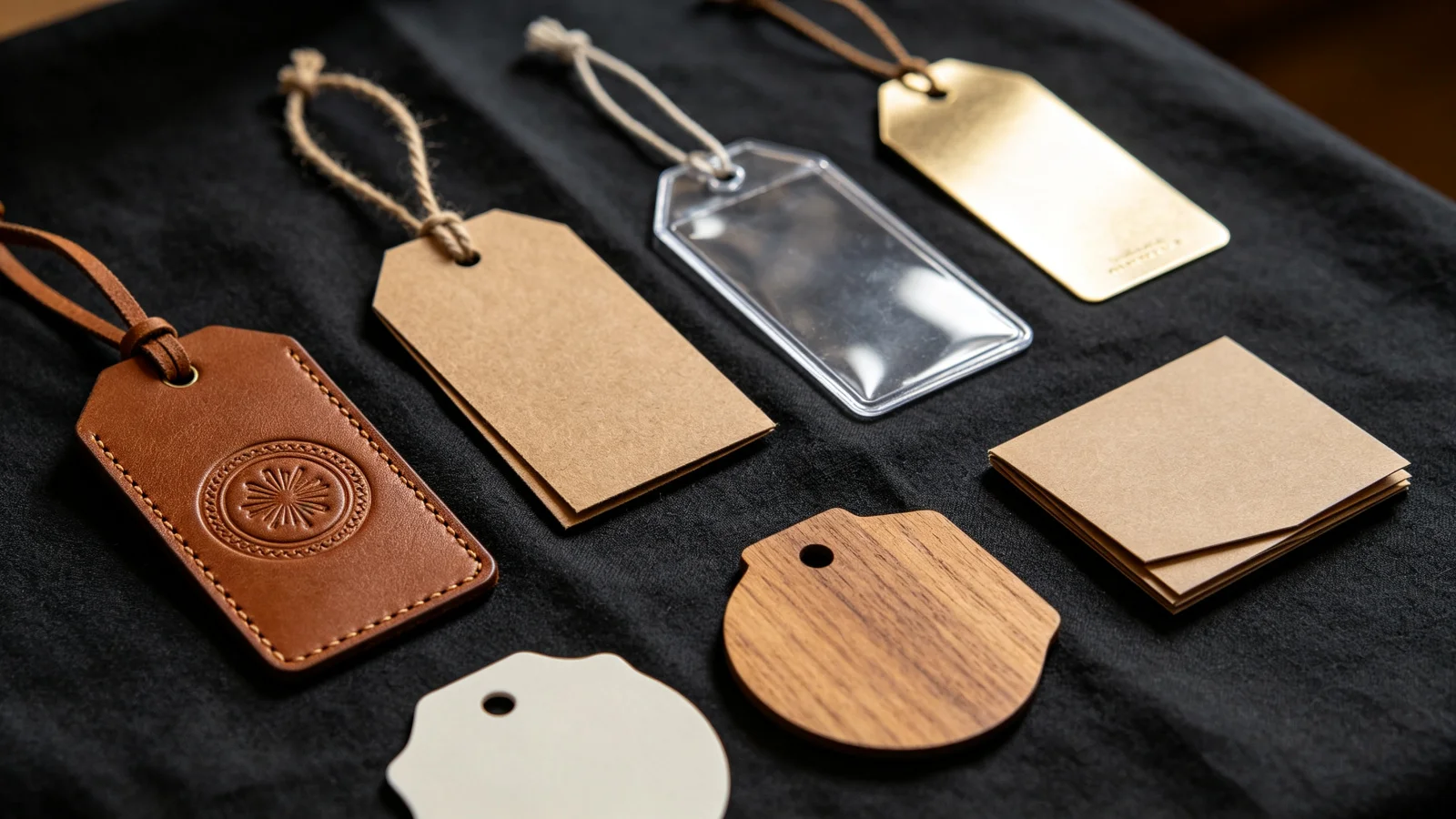
| Material | Typical Cost (1,000 pcs) | Best For | Durability | Perceived Value |
|---|---|---|---|---|
| 300gsm Cardstock | $0.05-$0.12 | Mass market, fast fashion | Medium | Standard |
| 400-600gsm Thick Card | $0.08-$0.20 | Premium retail, boutique | High | Premium |
| Kraft Paper | $0.06-$0.15 | Eco-friendly, minimalist brands | Medium | Natural/eco |
| Leather / PU Leather | $0.30-$0.80 | Luxury leather goods | Very High | Luxury |
| Clear Plastic / PVC | $0.10-$0.25 | Waterproof, modern aesthetic | High | Modern |
| Metal / Aluminum | $0.50-$1.50 | Ultra-premium, limited edition | Very High | Luxury |
| Wood / Bamboo | $0.40-$1.00 | Eco-luxury, sustainable brands | High | Premium/eco |
What to Include on a Hang Tag
A well-designed hang tag includes these elements (front and back):
- Front: Brand logo, product name or collection name, hero image or illustration, tagline
- Back: Product features/materials, care instructions (brief version), brand story (1-2 sentences), website/social media, barcode (optional — usually on a separate sticker), price (for retail — usually a sticker, not printed)
Hang Tag Printing Techniques
- Offset printing (CMYK): Best for full-color designs, photos, gradients. Minimum 500 pcs. Cost-effective for large runs.
- Screen printing: Best for solid colors, simple designs. Vibrant color, thick ink. Good for kraft paper and cardstock.
- Foil stamping (hot stamping): Gold, silver, rose gold, holographic foil. Adds premium feel. $0.05-$0.15 extra per tag.
- Embossing / debossing: Raised or recessed logo without ink. Tactile premium feel. $0.08-$0.20 extra per tag.
- UV spot coating: Glossy coating on specific areas (logo, image). Creates contrast with matte background. $0.05-$0.10 extra.
- Die-cutting: Custom shapes (not just rectangles). $0.10-$0.30 extra per tag + die setup fee ($50-$150).
Care Labels: Fiber Content & Washing Instructions
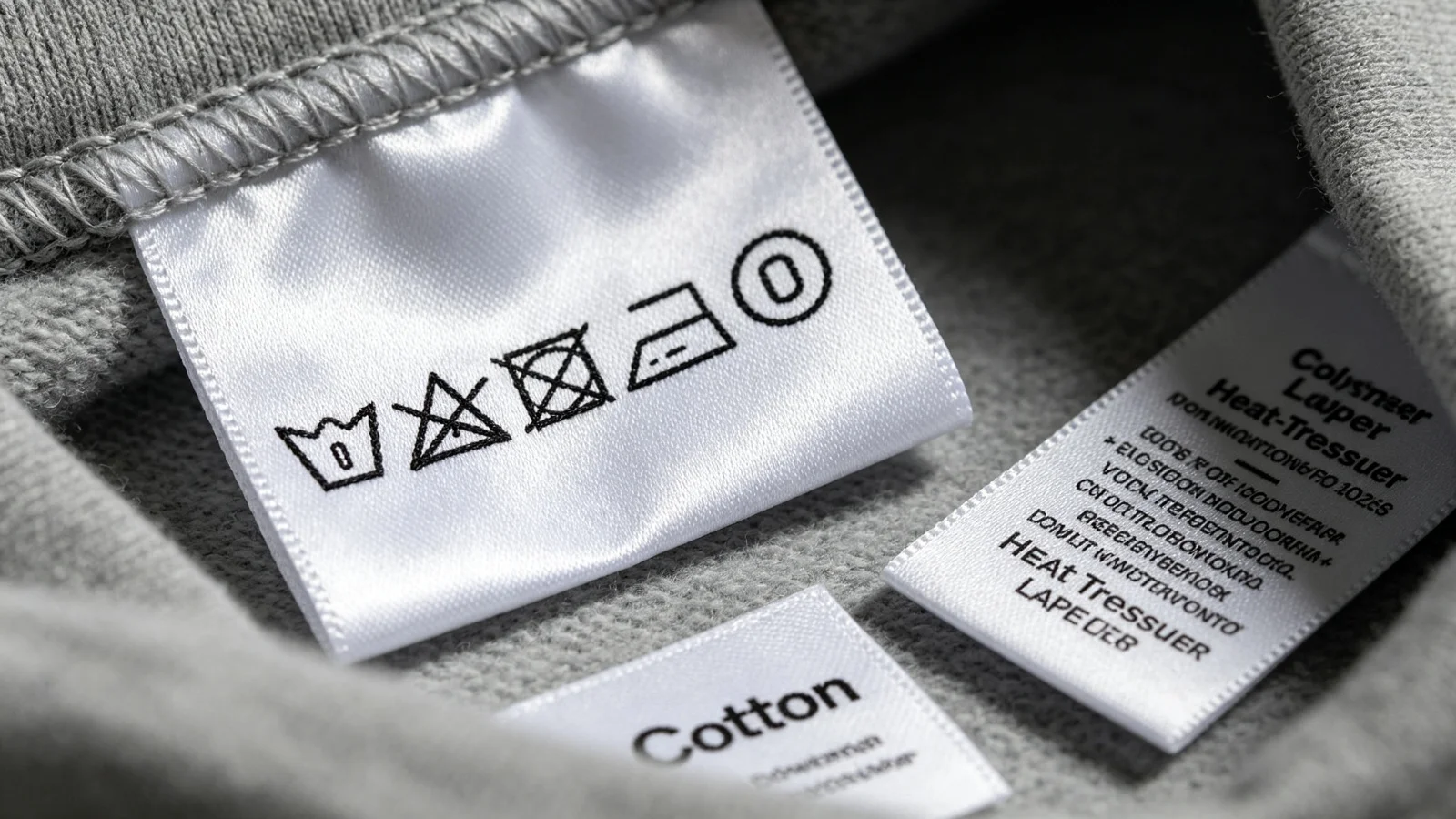
Care labels (also called wash labels or content labels) are legally required for textile products sold in the US, EU, UK, and most other markets. They serve two purposes: (1) informing the consumer about fiber content and how to care for the product, and (2) protecting the brand from liability if the product is damaged due to improper care.
What Must Be on a Care Label
| Element | US Requirement | EU Requirement | UK Requirement |
|---|---|---|---|
| Fiber content | Required (TFPIA) — generic fiber names, percentage by weight | Required (Reg 1007/2011) — percentage by weight | Required (Textile Products Regs 1986) |
| Country of origin | Required (can be on care label or separate label) | Required (must be visible to consumer) | Required |
| Care instructions | Required (FTC Care Labeling Rule) — at least one safe method | Recommended (not legally mandatory but expected) | Recommended |
| Manufacturer/Importer ID | Required (RN number or brand name) | Not required | Not required |
| Language | English | Language(s) of destination country | English |
Care Label Materials
- Woven label (damask/satin): The most common and durable option. Text is woven into the fabric, not printed. Cost: $0.03-$0.08 each. Best for bags that will be washed frequently.
- Printed polyester/nylon label: Text printed on synthetic fabric. Cost: $0.02-$0.05 each. Less durable than woven but cheaper. Good for bags that won't be washed.
- Cotton printed label: Natural fiber, soft hand feel. Cost: $0.03-$0.06 each. Can fade with washing. Good for eco-friendly brands.
- Heat transfer label: Printed directly onto the bag lining using heat press. No sewing needed. Cost: $0.02-$0.05 each. Clean, minimalist look. Can peel off with frequent washing.
- Leather/PU label: Debossed or printed on leather. Cost: $0.15-$0.40 each. Premium look. Usually used for brand label, not care label.
Country of Origin: The Label That Gets Shipments Detained
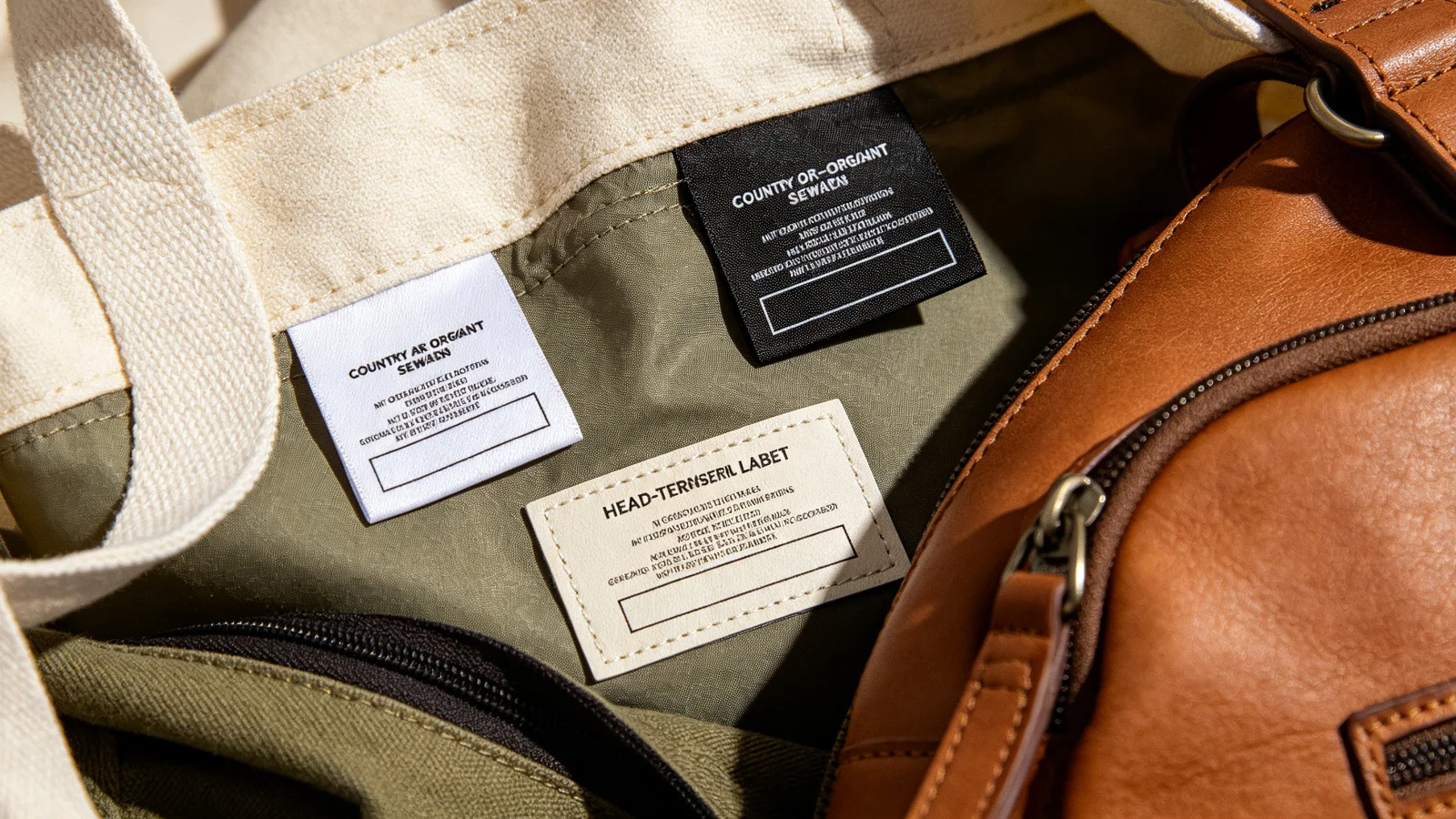
Country of origin (COO) labeling is the single most common reason for customs detention of bag shipments. The rules are simple but frequently misunderstood: every product imported into the US, EU, or UK must have a clear, visible, permanent label indicating the country where it was manufactured.
US Requirements (19 CFR 134)
- Location: Must be on the product itself (not just the packaging), in a conspicuous place, visible to the consumer at the point of purchase.
- Method: Must be permanent — sewn label, printed label, or embossed/debossed. Stickers are generally not acceptable for the product itself (but are acceptable for packaging).
- Wording: "Made in China" or "Made in PRC" (People's Republic of China). "China" alone is acceptable but "Made in China" is preferred.
- Language: English required. Additional languages optional.
- Exception: If the product is too small or the nature of the product makes labeling impractical, a label on the immediate packaging is acceptable. This rarely applies to bags.
EU Requirements (Regulation 2018/1581 / Customs Code)
- Location: Must be on the product or its packaging, visible and accessible.
- Method: Indelible marking — sewn, printed, or stamped.
- Wording: "Made in China" or equivalent in the language of the destination country (e.g., "Fabriqué en Chine" for France, "Hergestellt in China" for Germany).
- Important: EU rules are less prescriptive than US rules but enforcement varies by member state. Germany and France are particularly strict.
UK Requirements (Post-Brexit)
- Following Brexit, the UK follows its own rules (Taxation (Cross-border Trade) Act 2018).
- Requirements are similar to the US: product must be marked with country of origin in English, visible to consumer.
- "Made in China" is acceptable.
Barcodes: UPC, EAN & FNSKU Explained
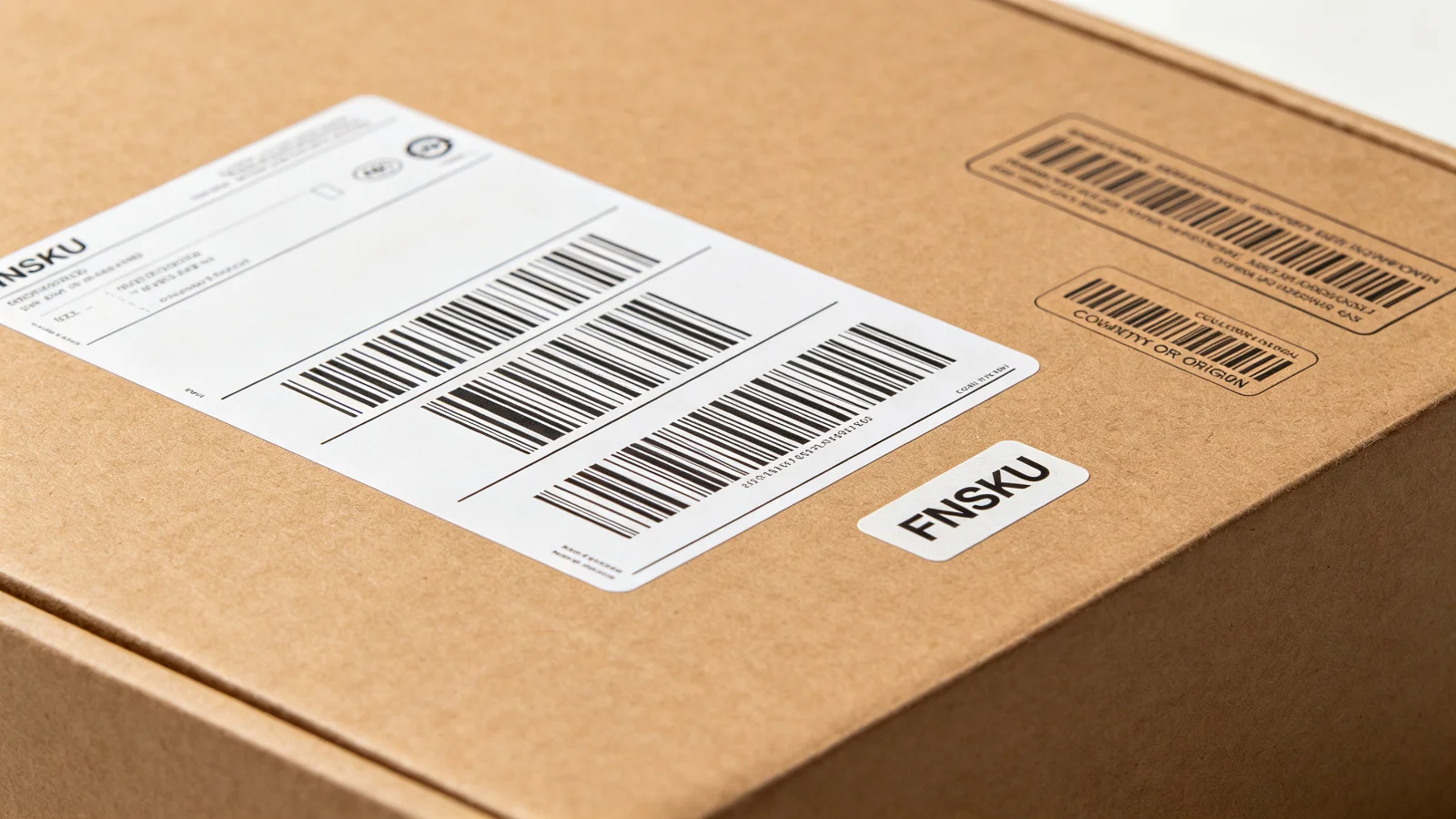
Barcodes are the universal language of retail. Every bag sold through a retailer, marketplace, or POS system needs a barcode. There are three types you need to understand: UPC (North America), EAN (Europe/international), and FNSKU (Amazon-specific).
UPC (Universal Product Code)
- Format: 12-digit number, used primarily in the US and Canada.
- Issuer: GS1 US (gs1us.org). You must purchase a GS1 Company Prefix to generate legitimate UPCs.
- Cost: $75 initial fee + $50/year renewal for 10 barcodes (GS1 US 2026 pricing). Bulk pricing available for larger prefixes.
- Important: Avoid buying "cheap UPCs" from third-party sellers — these are often recycled or stolen numbers that can get your listing removed from Amazon or rejected by retailers.
EAN (European Article Number)
- Format: 13-digit number, used in Europe and most international markets.
- Issuer: GS1 (local GS1 member organization in your country).
- Cost: Varies by country. Typically €50-€200 initial + annual renewal.
- Note: A 12-digit UPC can be converted to a 13-digit EAN by adding a leading "0." Most retailers worldwide accept both formats.
FNSKU (Fulfillment Network Stock Keeping Unit)
- Format: Amazon-specific barcode, starts with "X00" followed by 7 digits.
- Issuer: Amazon — generated automatically when you create a listing in Seller Central.
- Cost: Free (included with Amazon seller account).
- When to use: Required for all products sent to Amazon FBA warehouses. The FNSKU is how Amazon identifies and tracks your inventory in their fulfillment network.
- Application: Must be printed as a sticker and applied to each unit (or printed directly on retail packaging). Must be scannable and not cover other important labels.
| Barcode Type | Digits | Issuer | Cost | Used For |
|---|---|---|---|---|
| UPC | 12 | GS1 US | $75+ / year | US/Canada retail, POS systems |
| EAN | 13 | GS1 (local) | €50-200 / year | Europe/international retail |
| FNSKU | 10 (X00+7) | Amazon | Free | Amazon FBA inventory tracking |
| SKU | Variable | You (brand) | Free | Internal inventory management |
Retail Packaging: From Poly Bags to Gift Boxes
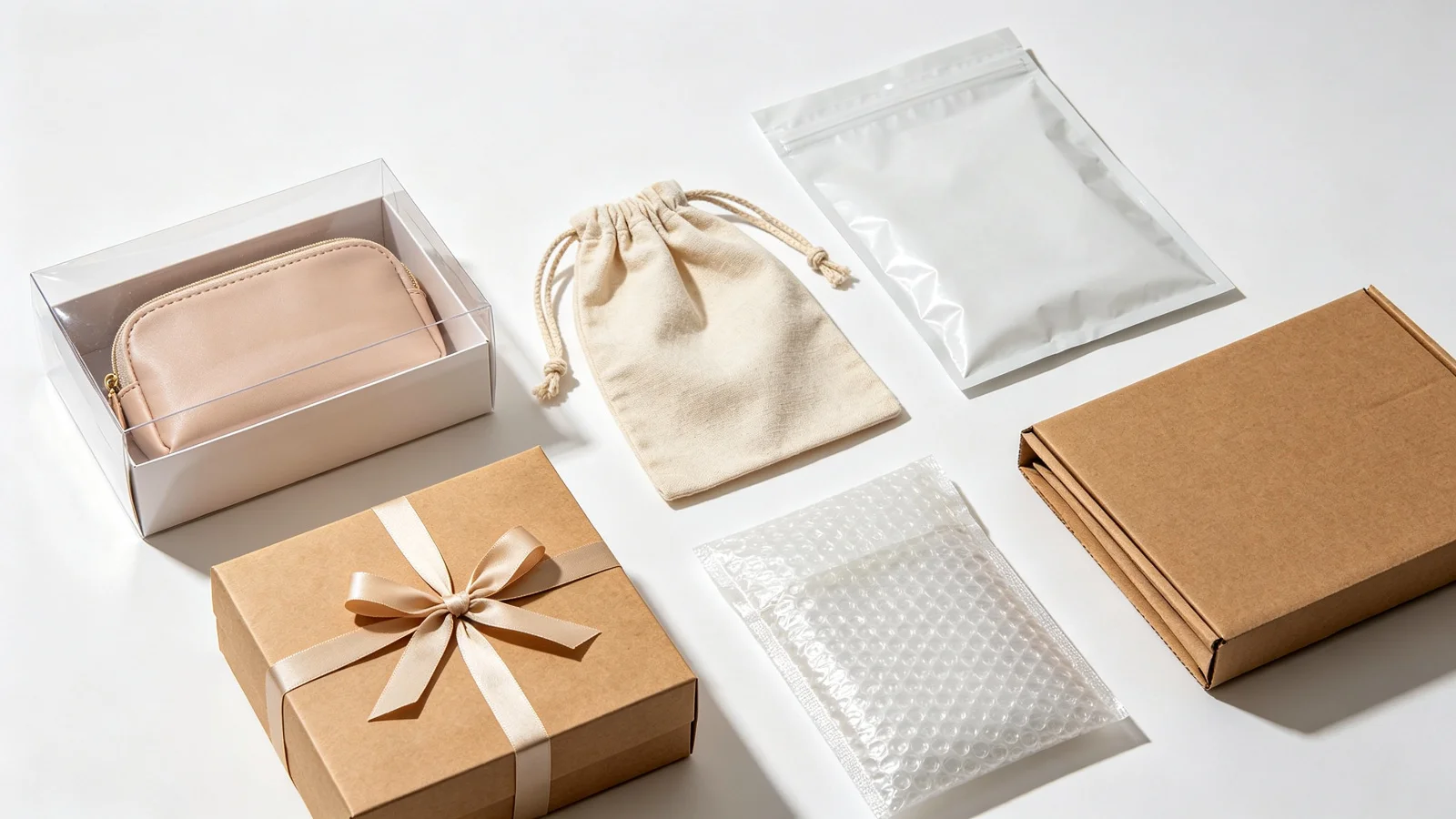
Packaging is more than just a way to protect your bag during shipping — it's part of the product experience. The right packaging increases perceived value, reduces returns, and creates shareable unboxing moments. The wrong packaging damages your brand and costs you money.
Packaging Options by Channel
| Packaging Type | Cost/Unit | Best For | Protection | Perceived Value |
|---|---|---|---|---|
| PE Poly Bag | $0.03-$0.08 | Wholesale, bulk shipments | Low (dust only) | Low |
| Non-Woven Bag | $0.08-$0.20 | Mid-range retail, eco brands | Medium | Medium |
| Cotton Dust Bag | $0.20-$0.60 | Premium, luxury bags | Medium | High |
| Poly Mailer | $0.10-$0.25 | DTC ecommerce shipping | Medium (waterproof) | Low-Medium |
| Bubble Mailer | $0.15-$0.35 | DTC, fragile items | High (padded) | Medium |
| Cardboard Box | $0.30-$1.00 | Premium DTC, subscription | High | High |
| Window Box (PVC) | $0.50-$1.50 | Retail display, gift | Medium | Very High |
| Rigid Gift Box | $1.00-$3.00 | Luxury, limited edition | Very High | Luxury |
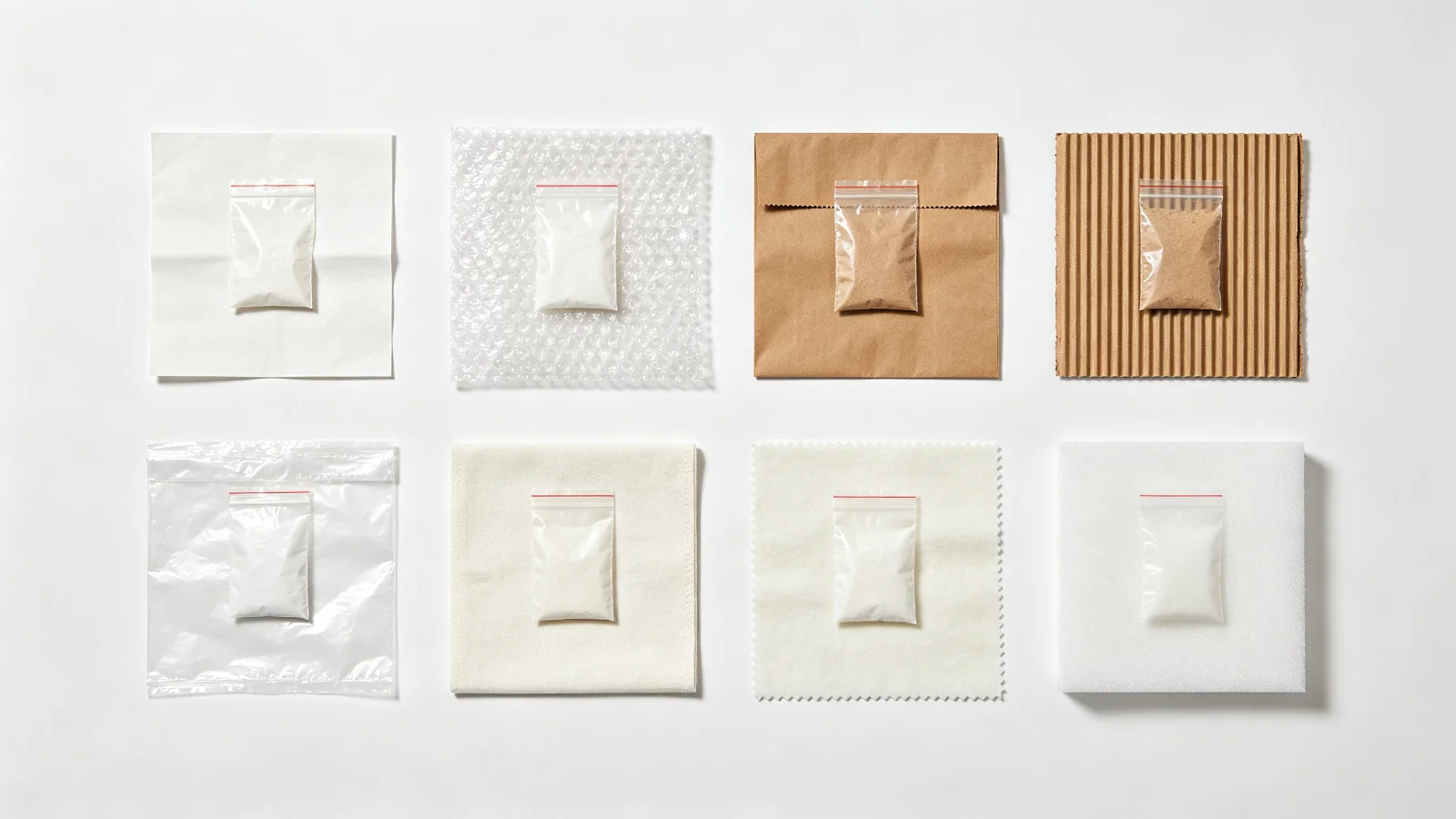
Packaging Materials Comparison
Packaging & Labeling Requirements by Market
| Requirement | United States | European Union | United Kingdom | Australia | Japan |
|---|---|---|---|---|---|
| Country of Origin | Required (19 CFR 134) | Required (Customs Code) | Required | Required (Commerce Act) | Required |
| Fiber Content | Required (TFPIA) | Required (Reg 1007/2011) | Required | Required | Required (Household Goods Quality Labeling Law) |
| Care Instructions | Required (FTC) | Recommended | Recommended | Recommended | Required |
| Importer ID | Required (RN #) | Not required | Not required | Not required | Not required |
| Language | English | Local language(s) | English | English | Japanese |
| Barcode | UPC (12-digit) | EAN (13-digit) | EAN (13-digit) | EAN (13-digit) | JAN (13-digit) |
| Recycling Label | Optional (state varies) | Required (Green Dot in DE/FR) | Required (WRAP) | Required (national) | Required |
Amazon FBA Packaging & Labeling Requirements
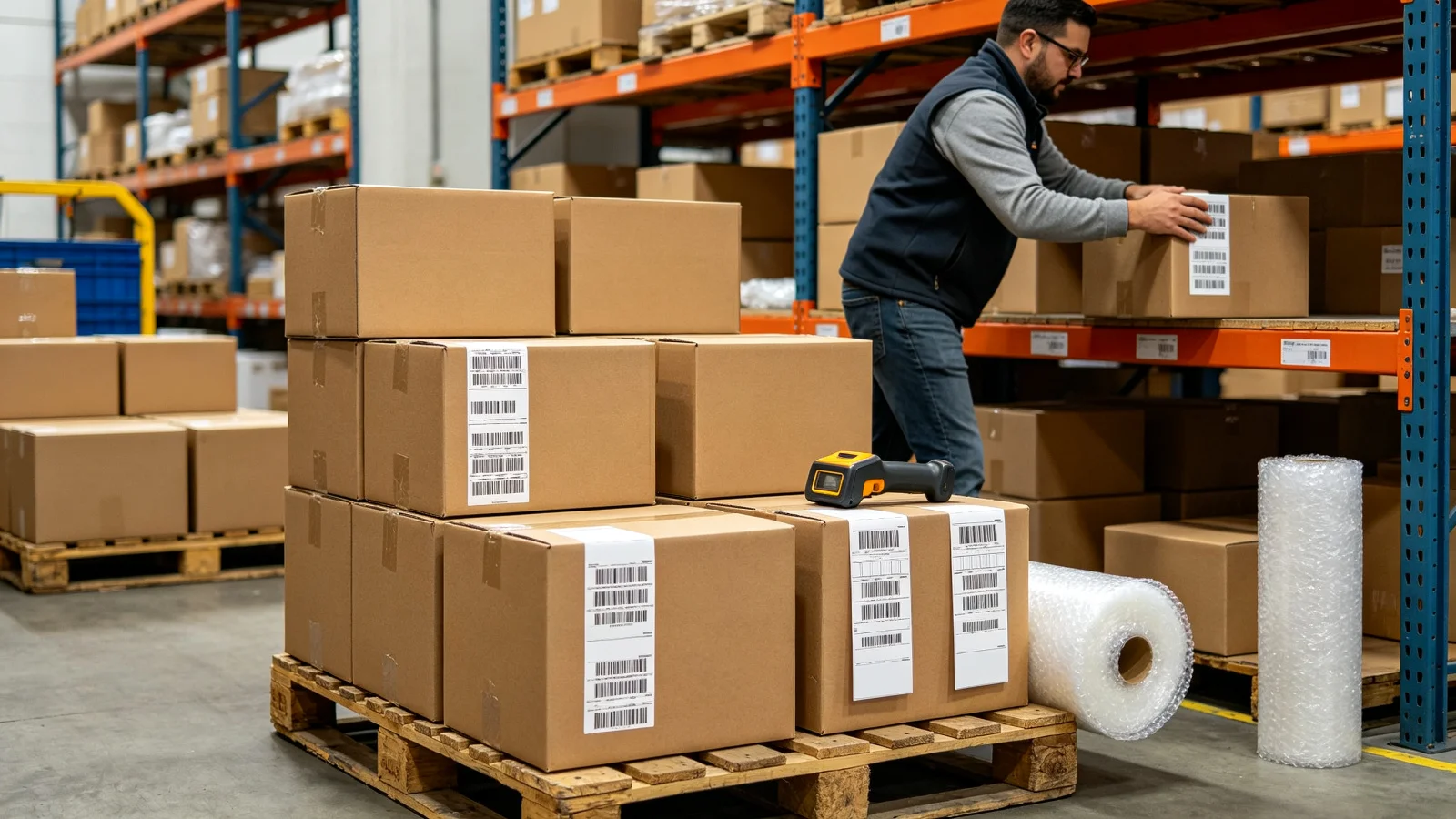
Amazon has the most specific and strictly enforced packaging requirements of any marketplace. Non-compliant shipments are refused at the warehouse, returned at your expense, or charged with unplanned prep fees ($0.50-$1.50 per unit).
FBA Packaging Rules
- Each unit must be individually packaged. Loose items (like a bag without a poly bag) will be refused. Use a clear poly bag (minimum 1.5 mil thickness) or retail packaging.
- Poly bags must have a suffocation warning. For bags with opening >5 inches (12.7cm), print "WARNING: CHOKING HAZARD — This bag is not a toy. To avoid danger of suffocation, keep this bag away from babies and children."
- FNSKU barcode must be scannable. Print on white label with black barcode, minimum 1.5" x 1" (38x25mm). Apply to flat surface, not on seams or curves.
- Cover all other barcodes. Any UPC, EAN, or manufacturer barcode on the packaging must be covered with a white sticker so the FNSKU is the only scannable barcode.
- No promotional materials inside packaging. No business cards, flyers, or coupons that direct customers outside Amazon. This is a violation that can get your account suspended.
- Expiration dates (if applicable). For products with expiration (rare for bags), must be labeled with MM-DD-YYYY format on both unit and carton.
FBA Carton Requirements
- Carton weight: Maximum 50 lbs (22.7 kg) per carton. If over 50 lbs, label "Team Lift" on all sides. Over 100 lbs = "Mech Lift."
- Carton dimensions: No side may exceed 25 inches (63.5cm), unless the unit itself is over 25 inches.
- Carton labels: Two FBA carton labels (one on top, one on side) with barcode. Include Amazon shipment ID, from address, to address.
- Mixed SKUs: If a carton contains multiple SKUs, label "Mixed SKU" on all sides. Each unit must still have its own FNSKU.
How to Calculate Packaging Cost
Packaging cost is one of the most commonly underestimated expenses in bag manufacturing. A $0.50 per-unit packaging cost doesn't sound like much — until you multiply it by 5,000 units and add in design, setup, and shipping costs.
Per-Unit Packaging Cost Breakdown
| Component | Budget Option | Standard Option | Premium Option |
|---|---|---|---|
| Poly bag / inner bag | $0.03 | $0.08 (non-woven) | $0.30 (cotton) |
| Hang tag | $0.05 (300gsm) | $0.12 (400gsm + foil) | $0.50 (leather) |
| Care label | $0.02 (printed) | $0.05 (woven) | $0.08 (woven satin) |
| COO label | $0.01 (printed) | $0.03 (woven) | $0.05 (embossed) |
| Barcode sticker | $0.01 | $0.02 | $0.03 (printed on box) |
| Outer packaging | $0.10 (poly mailer) | $0.30 (cardboard box) | $1.00 (rigid gift box) |
| Tissue paper / filler | $0.02 | $0.05 (branded) | $0.15 (custom printed) |
| Carton (amortized) | $0.02 | $0.03 | $0.05 |
| Total per unit | $0.26 | $0.68 | $2.16 |
10 Packaging & Labeling Mistakes to Avoid
Need Packaging & Labeling for Your Bag Order?
At MerrisBags, we handle all packaging and labeling in-house — hang tags, care labels, country of origin, barcodes, poly bags, retail boxes, and FBA-compliant packaging. Send us your design files and we'll handle the rest. Get a free quote today.
Get a Free Quote & Sample View Our ServicesFrequently Asked Questions
Do I need a country of origin label on every bag?
Yes. The US (19 CFR 134), EU (Customs Code), UK, and most other countries require every imported product to be clearly labeled with its country of origin. The label must be on the product itself (not just the packaging), in a conspicuous place visible to the consumer, and permanent (sewn, printed, or embossed — not a removable sticker). For bags, the most common location is the inside lining, sewn near the care label.
What's the difference between UPC, EAN, and FNSKU?
UPC is a 12-digit barcode used primarily in the US and Canada, issued by GS1 US. EAN is a 13-digit barcode used in Europe and internationally, issued by local GS1 organizations. A UPC can be converted to an EAN by adding a leading "0." FNSKU is an Amazon-specific barcode (starts with "X00") generated automatically when you create an Amazon listing. It's required for all FBA shipments and is how Amazon tracks your inventory in their warehouses. For retail sales outside Amazon, you need a UPC or EAN. For Amazon FBA, you need an FNSKU (and should cover any UPC/EAN on the packaging).
Can the factory provide all the labels and packaging?
Yes, most bag factories (including MerrisBags) can source and apply all labels and packaging in-house — hang tags, care labels, country of origin labels, barcodes, poly bags, and retail boxes. You provide the design files (AI, PDF, or EPS) and specifications, and the factory handles printing, sewing, and application. This is almost always cheaper and more efficient than sourcing packaging separately and shipping it to the factory. Always request a pre-production sample with all labels and packaging applied before mass production.
How much does packaging and labeling cost per bag?
Budget $0.15-$0.80 per unit for full packaging and labeling, depending on your choices. Budget option (poly bag, basic hang tag, printed care label, COO sticker): $0.15-$0.30. Standard option (non-woven bag, 400gsm hang tag with foil, woven care label, woven COO, cardboard box): $0.40-$0.80. Premium option (cotton dust bag, leather hang tag, woven satin labels, rigid gift box, branded tissue): $1.00-$3.00. As a rule of thumb, budget 3-8% of your product's retail price for packaging.
What information must be on a care label?
For the US market (FTC requirements), a care label must include: (1) fiber content by percentage (e.g., "80% Cotton, 20% Polyester"), (2) country of origin ("Made in China"), (3) at least one safe care instruction (e.g., "Wipe clean with damp cloth"), and (4) manufacturer or importer identification (RN number or brand name). For the EU, fiber content and country of origin are legally required; care instructions are recommended but not mandatory. For bags that won't be washed (like most leather or PU bags), a simple "Wipe clean" instruction is sufficient.
Do I need an RN number for my bags?
An RN (Registered Identification) number is required by the US FTC for any apparel or textile product sold in the US, including bags with textile components. The RN number identifies the manufacturer, importer, or distributor. You can apply for an RN number for free on the FTC website (ftc.gov). It takes 1-3 business days. Alternatively, you can use your brand name on the care label instead of an RN number — the FTC allows either. Most brands use their brand name for simplicity. If you're selling exclusively outside the US, an RN number is not required.
What are Amazon FBA packaging requirements for bags?
Amazon FBA requires: (1) each bag individually packaged in a clear poly bag (minimum 1.5 mil thickness) or retail packaging, (2) suffocation warning printed on poly bags with opening >5 inches, (3) FNSKU barcode on each unit (white label, black barcode, minimum 1.5"x1"), (4) all other barcodes (UPC/EAN) covered with white stickers, (5) no promotional materials inside the packaging, (6) cartons under 50 lbs and 25 inches per side, (7) two FBA carton labels per carton. Non-compliant shipments are refused, returned, or charged prep fees of $0.50-$1.50 per unit.
Can I use the same packaging for all markets?
Not entirely. While the basic packaging (poly bag, hang tag, care label) can be similar across markets, labeling requirements differ: the US requires English labels and RN number; the EU requires labels in the local language(s) and may require recycling labels (Green Dot in Germany/France); the UK requires English labels and WRAP recycling labels; Japan requires Japanese-language labels. Country of origin wording also varies ("Made in China" works for US/UK, but EU may require local language translation). For multi-market sales, either produce market-specific label variants or use a multi-language label that covers all your target markets.