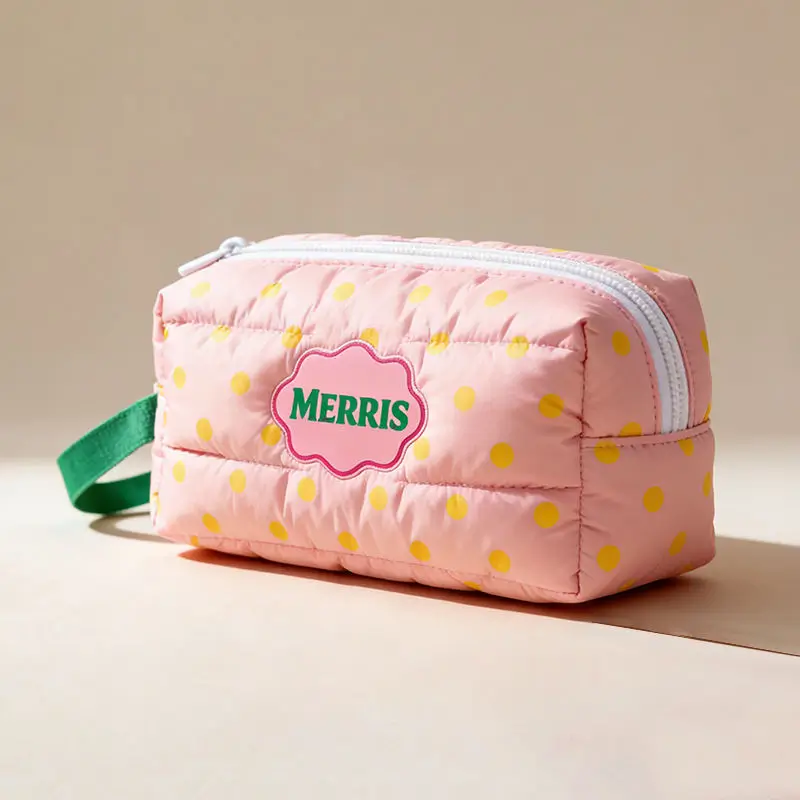
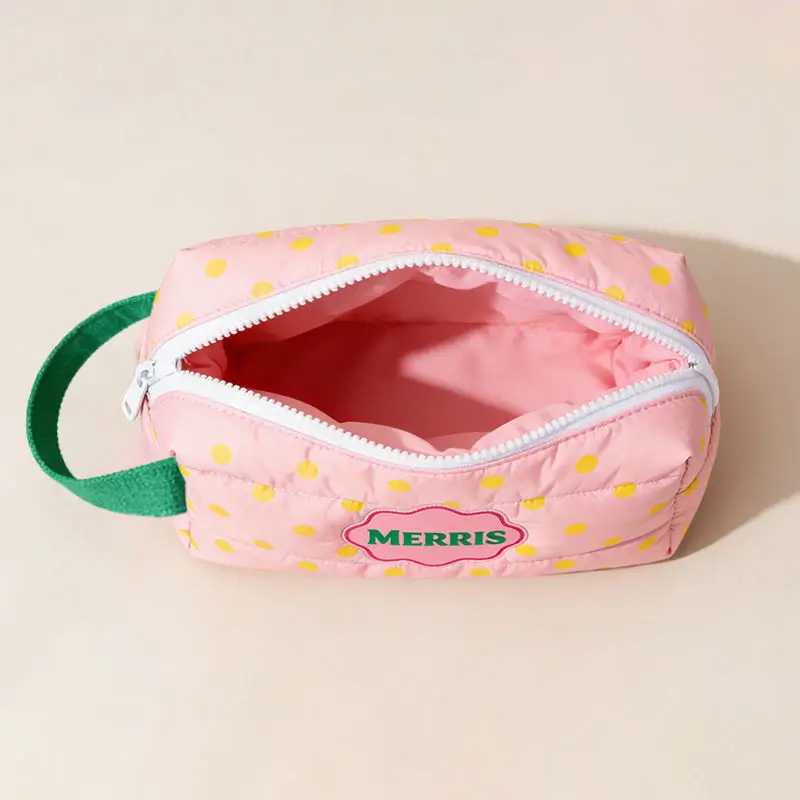
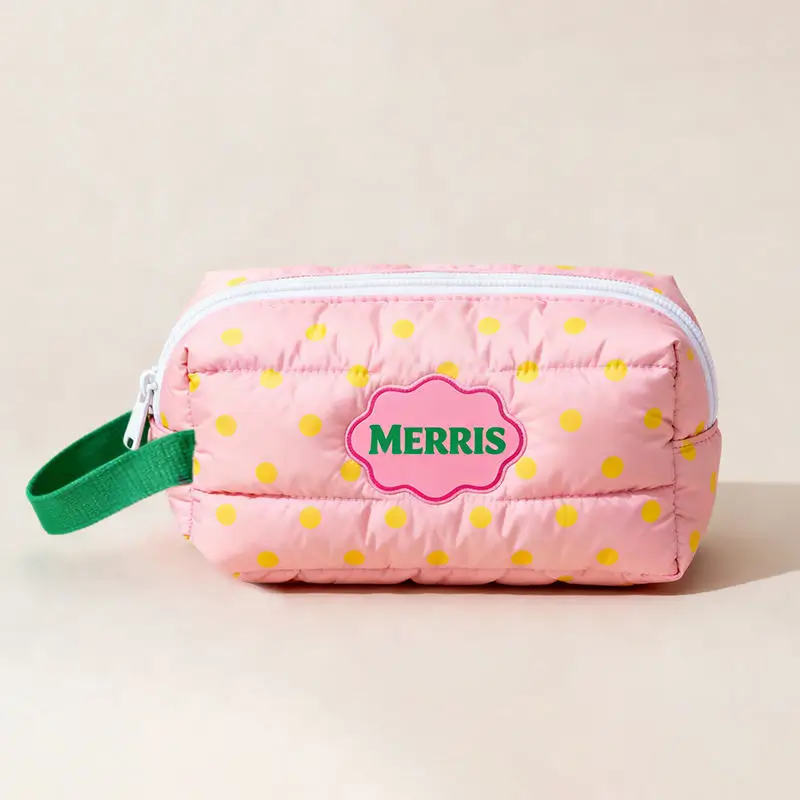
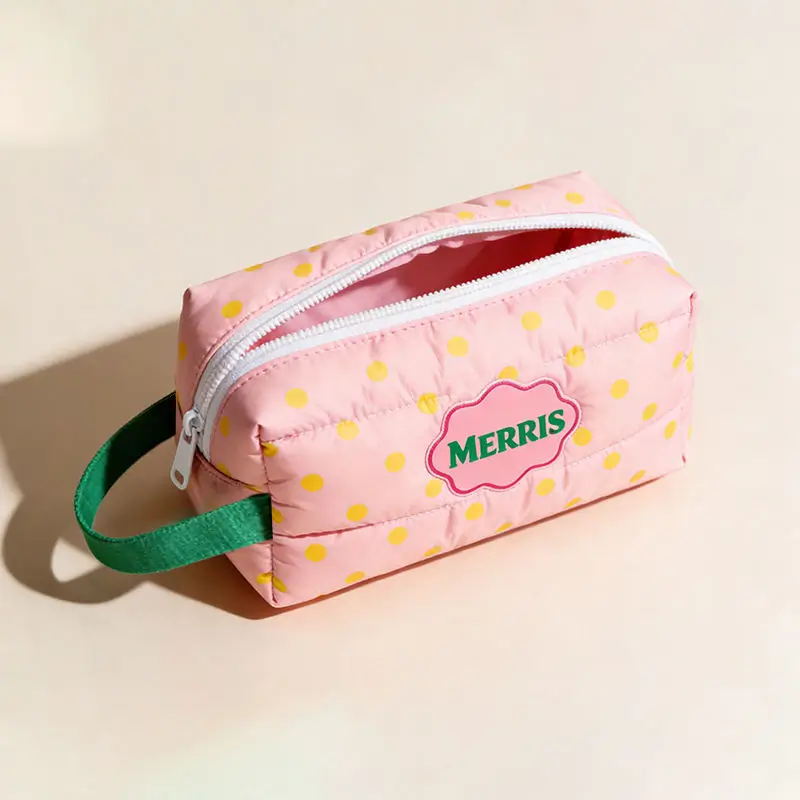
Pink fabric, yellow dots and horizontal padded channels give this cosmetic wristlet its character. A green side loop and white zipper add contrast, while a scalloped front badge carries the MERRIS sample mark. The open view shows a pink-lined central space, without a demonstrated organizer pocket system.
MerrisBags accepts OEM/ODM development enquiries for this polka dot quilted pouch. Share the dot artwork, badge outline and intended carry contents together. The factory brief can then connect the quilt spacing, badge position and fixed-loop attachment instead of treating each as an unrelated decoration. Our OEM development process
Existing reference: US$1.58–2.15 per pouch at MOQ 500 units, FOB Shenzhen. This is a planning reference; material choice, badge construction, loop, colour quantity and packing need a dated project quotation.
The dots, horizontal stitching and shaped badge share the same front panel. Each can look right on its own and awkward after assembly. For a private-label wristlet, use the photographed layout as a starting point, then review the complete face with the actual badge and filled shape.
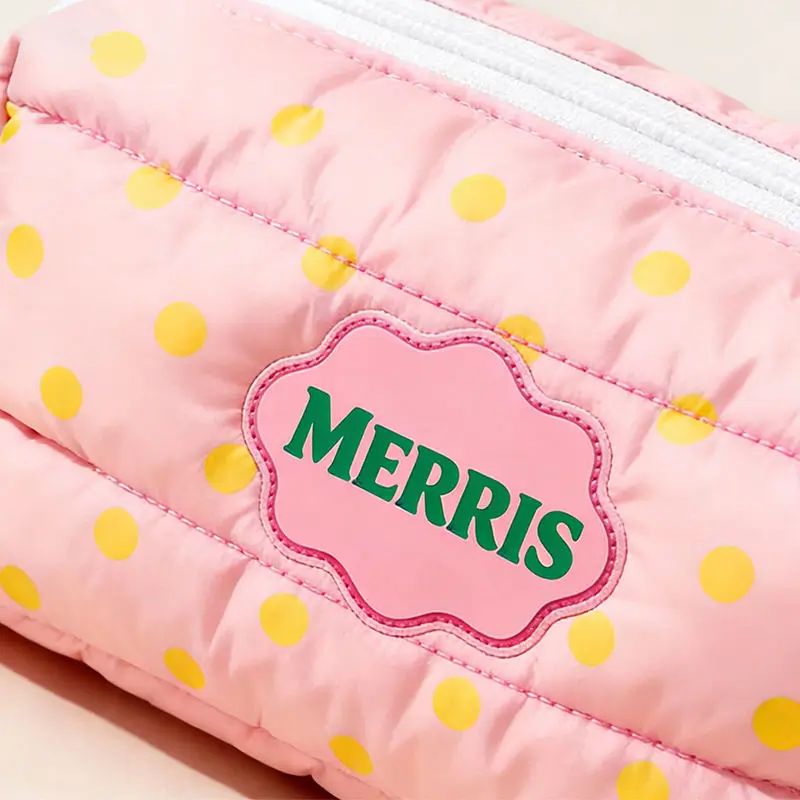
Front detail: a shaped badge sits over the dotted, horizontally quilted panel. Material and lettering method require a sample specification.
Develop the badge outline and lettering together
Photo 4 shows a pink scalloped badge with green lettering, a darker outline and visible stitching around its edge. It does not establish the badge material or lettering process. Send the complete outline with your artwork, not just the wordmark. Keep a border around the text and decide how the badge sits relative to the horizontal channels.
A practical order for developing the front panel
Set the dot repeat
Specify dot size, spacing and ground colour. Mark whether a partial dot near an edge is acceptable; do not ask for an undefined “same as photo” repeat.
Place the channel lines
The reference uses horizontal rows, not diamonds. Decide the line positions on a finished panel and review how stitches cross the dots and badge area.
Fit the badge to the sewn pouch
Check the badge outline and text after padding and assembly. A mark centred on a flat drawing can appear offset when the front face rounds around its contents.
A fixed loop needs a finished-pouch check
The green loop appears attached directly at the side, with no detachable clasp shown. Its usable opening and attachment reinforcement are not measured in the images. If wrist carry is part of the product brief, specify the intended contents and a suitable attachment test. Record the agreed load, pull direction and pass condition for the assembled sample.
Keep the inside description simple
The open reference shows pink lining around a main storage space. No internal zip pocket, elasticated bottle section or brush sleeve is clearly demonstrated. If your kit needs separation, draw that addition explicitly. Compare access with the zipper open and check that an item does not push the quilted panel or badge into an unwanted shape.
What belongs in this model’s specification
Model
DOT-WRIST-001
Visible design
Pink ground, yellow dots, horizontal quilting, white zipper and green fixed side loop.
Branding reference
Scalloped front badge with outlined edge stitching and green MERRIS sample lettering.
Earlier reference: 22 × 6 × 12 cm. No measured dimensions in the supplied images.
Order planning
Made to order. Existing reference MOQ 500 pouches; quantities by colour and final specification are quotation inputs.
Review the badge and padding after packing
The padded face may change under compression, and the front badge is another contact surface. Open a representative packed sample and check channel fullness, badge edges, zipper line and loop placement after an agreed recovery interval. Neither shock protection nor waterproof performance is established by the puffy appearance.
No. The supplied reference images show horizontal stitched channels across the front and sides. If you want diamond quilting, treat it as a separate pattern development and review the changed dot placement, padding and finished shape on a new sample.
Is the wrist loop detachable?
No detachable hook or clasp is shown. The green loop appears fixed at the side. A detachable strap requires a different attachment proposal; specify the hardware and usable loop length rather than assuming they are included in this reference.
Can my brand replace the scalloped MERRIS badge?
That badge is the visible branding starting point. Send your outline and artwork, then confirm the badge material, lettering process, edge finish and attachment on a sample. The photo does not verify a particular printing or embroidery method.
How should the side-loop attachment be evaluated?
Specify the maximum intended contents, pull direction and a relevant test method for the assembled pouch. Review the loop, attachment seam and body together, then record the result and acceptance condition. No load rating is established by the supplied photographs.
Are there organizer pockets inside?
The open view shows a pink-lined main space, without a clearly demonstrated pocket system. Add a drawing if your project needs separate brush sleeves or small-item sections. The extra structure should be assessed with the intended kit packed inside.
Are the lining denier and size confirmed?
210D lining and 22 × 6 × 12 cm are earlier development references, not values established by the photographs. Confirm the material specification, finished measurements and production tolerance before putting them in a purchase order or customer-facing description.